
Blog
Why a Real Estate Appraiser Isn't a Qualified Appraiser for Building Material Donations
A real estate license does not make someone a qualified appraiser for a deconstruction donation. Here is what the IRS actually requires, and why salvage valuation is a different discipline from appraising land and structures.
Donors who deconstruct a building before demolition often assume that any licensed appraiser can sign off on the resulting donation. That assumption causes more denied deductions than almost any other mistake in this space. The IRS defines "qualified appraiser" narrowly, and a real estate credential, by itself, does not satisfy that definition for donated building materials.
If your claimed deduction for salvaged lumber, doors, windows, brick, cabinetry, fixtures, or appliances exceeds $5,000, the appraiser who signs your report needs documented experience valuing those specific materials, not just experience valuing buildings. Our team appraises deconstruction and architectural salvage donations specifically, and we see the gap between the two disciplines trip up well-intentioned donors every year.
What Makes an Appraiser "Qualified" Under IRS Rules?
Under Treasury Regulation 1.170A-17, a qualified appraiser must hold a recognized appraisal designation from a professional organization, or have completed professional or college-level coursework plus at least two years of experience valuing the specific type of property being appraised. The regulation also requires the appraiser to regularly perform appraisals for compensation and to have verifiable education and experience in that particular property type.
That last requirement is the one donors overlook. General appraisal competence in one asset class does not transfer to another. An appraiser who has spent a career valuing single-family homes and commercial buildings has real expertise, but it is expertise in a different market, using different data, under different standards, than the market for used doors, reclaimed flooring, and architectural salvage.
For personal property appraisals like these, relevant credentials typically come from organizations such as the ISA, ASA, and AAA, alongside training specific to reclaimed and salvaged building materials. All of our appraisers prepare reports in accordance with USPAP, the Uniform Standards of Professional Appraisal Practice. A credential alone does not establish qualification for a specific assignment; the appraiser's documented experience with the actual property type does.
Real Estate Appraisal Is a Different Discipline Than Salvage Valuation
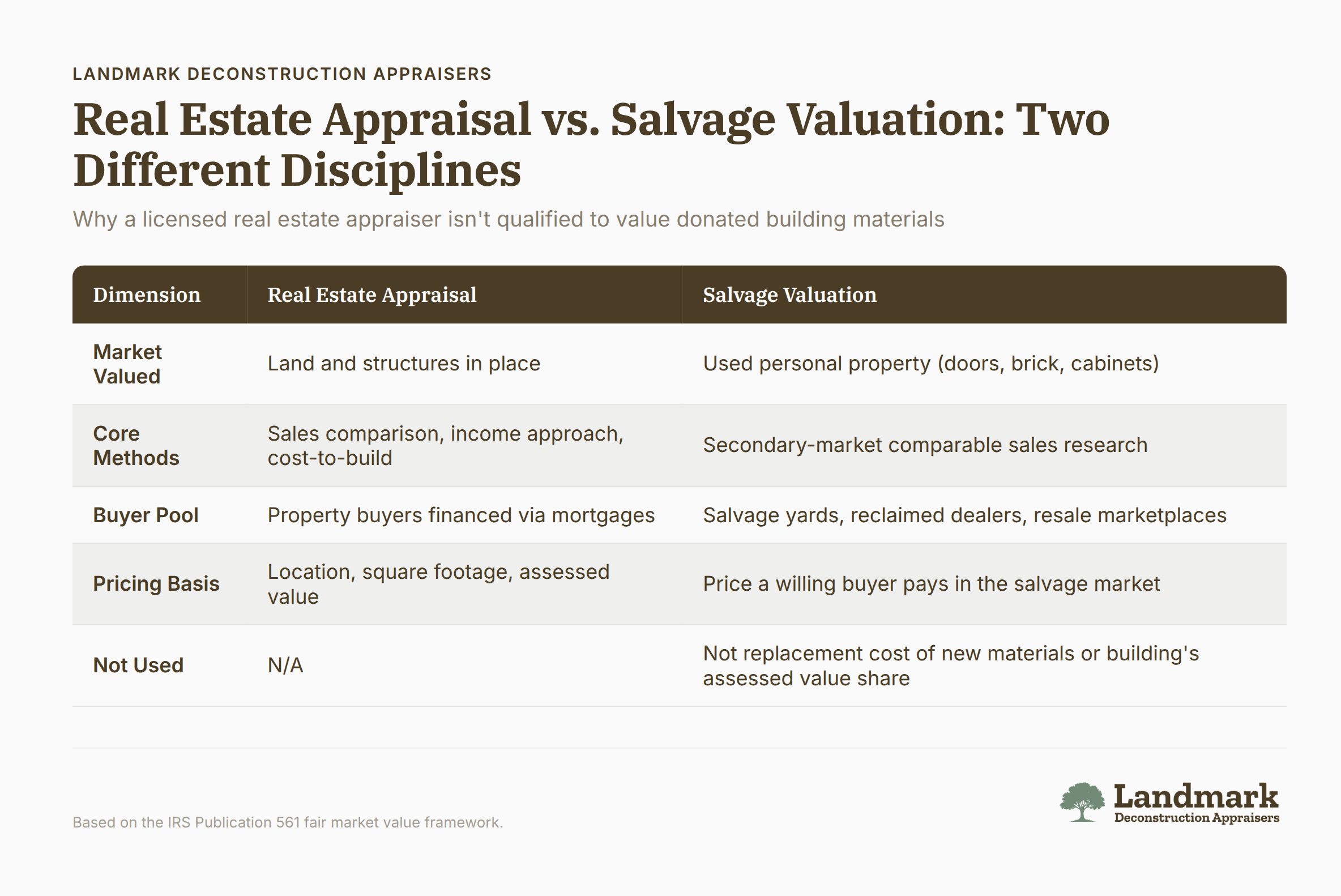
A licensed real estate appraiser values land and structures in place. The tools of that trade, sales comparison against comparable properties, the income approach, and cost-to-build analysis, are built around an entirely different market: buyers and sellers of real property, financed through mortgages, priced by location and square footage.
Deconstruction donations are a different animal. A donated door, a run of salvaged brick, or a set of reclaimed cabinets has to be valued as used personal property, sold on the secondary market to buyers who specifically want salvage and reclaimed materials. That requires research into architectural salvage yards, reclaimed materials dealers, and resale marketplaces where comparable items actually trade. Fair market value, as the IRS Publication 561 framework describes it, is the price a willing buyer would pay a willing seller in that actual market, not the replacement cost of new materials and not a share of the building's assessed value.
A real estate appraiser who has never priced used salvage against real secondary-market comparables simply does not have the data, the market knowledge, or (per the regulation) the verifiable experience to do this work defensibly. For more detail on how that valuation actually gets built item by item, see how fair market value is determined for salvaged building materials.
Why Cost-Estimating Software Doesn't Replace Comparable Sales Research
One shortcut shows up again and again in rejected deconstruction appraisals: running a construction cost-estimating program, the kind built for pricing new-build materials, and backing into a "value" for used salvage by applying a depreciation percentage to the new-material cost.
Watch out: Cost-estimating software is built to price new construction materials for contractors and insurers. It was never designed to capture what a reclaimed door or a stack of used brick actually sells for on the secondary market, and applying a flat depreciation factor to a new-material cost is not a substitute for finding real comparable sales.
Fair market value for used personal property is established through sales comparison: actual transactions or verifiable asking prices for similar used items in the relevant resale market. An appraiser who cannot point to real salvage-market comparables, and instead reverse-engineers a number from new-construction pricing data, has not performed the kind of analysis that holds up under IRS scrutiny.
The $5,000 Threshold and Form 8283 Section B
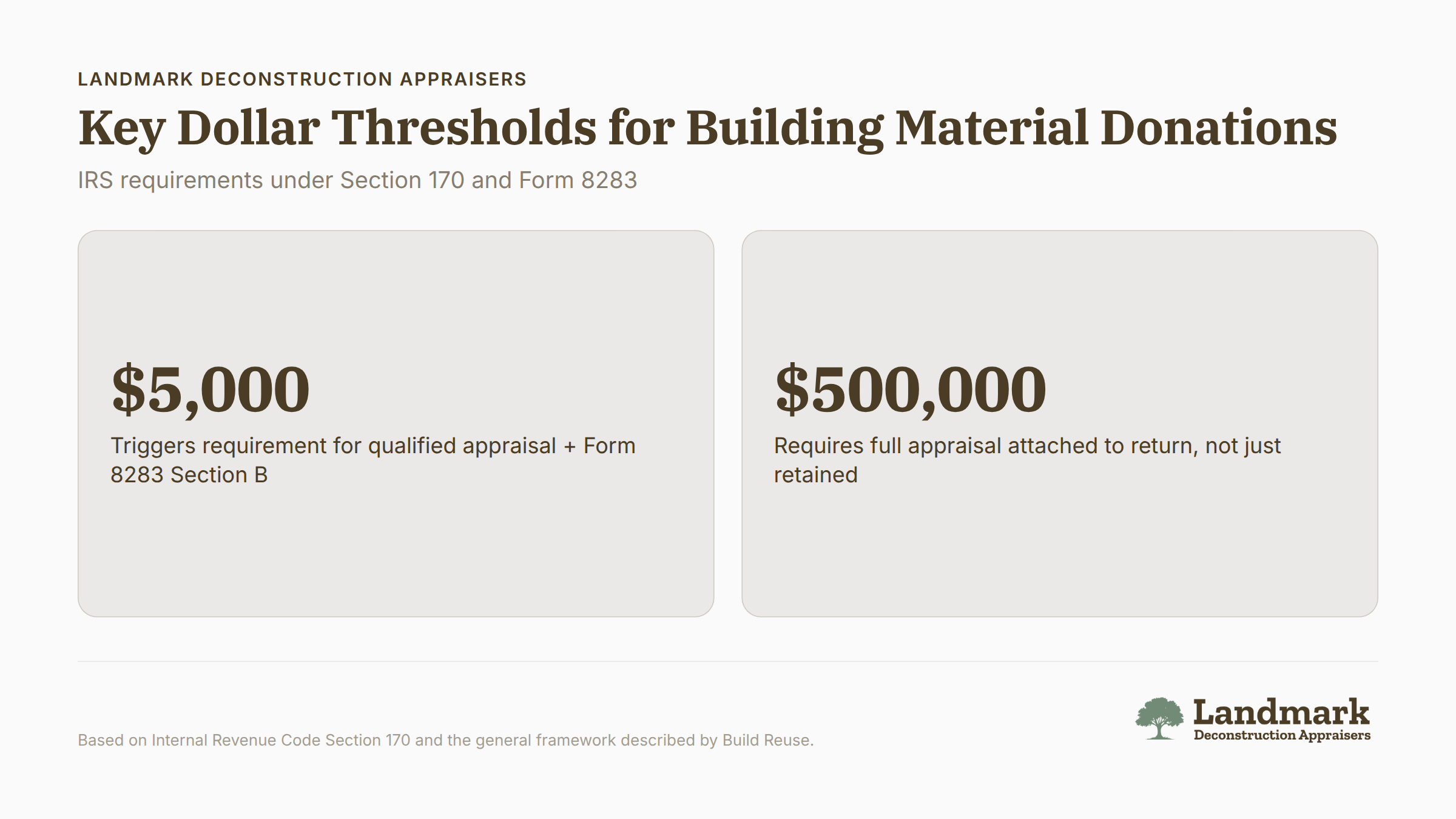
A qualified appraisal is generally required once the claimed deduction for an item or group of similar donated items exceeds $5,000, under the framework set out in Internal Revenue Code Section 170. Above that threshold, the donor completes Section B of Form 8283, and the appraiser must sign the required Declaration of Appraiser attesting to their qualifications for that specific property type.
Industry groups focused on building material reuse have echoed this same position: donors claiming more than $5,000 for a deconstruction donation should expect to obtain a qualified appraisal and attach the required documentation to their return, consistent with the general framework described by Build Reuse. Deductions above $500,000 carry an additional requirement to attach the full appraisal to the return rather than simply retaining it.
Our building material donation appraisal guidance walks through how that $5,000 threshold applies when a deconstruction project generates dozens of separate material categories, and our Form 8283 walkthrough covers exactly what Section B requires from the appraiser and the donor.
When Deconstruction Appraisals Have Fallen Apart
There is a recurring pattern in disputes over deconstruction donations: a sizable deduction gets claimed, the appraisal relies on construction cost-estimating software or new-material pricing rather than secondary-market comparables, and the appraiser's background turns out to be in real estate or general contracting rather than salvage valuation. When these cases are examined, the appraiser's qualifications and methodology are often the first thing challenged, not the condition of the materials themselves.
This is not a rare edge case. It is a known pattern specific to this niche of charitable giving, precisely because deconstruction sits at the intersection of construction, real estate, and personal property valuation, and it is easy for a donor to assume any appraiser familiar with buildings can handle it. This information is general in nature and should not be read as legal advice about any specific dispute or ruling.
How to Vet an Appraiser for Salvaged Building Materials
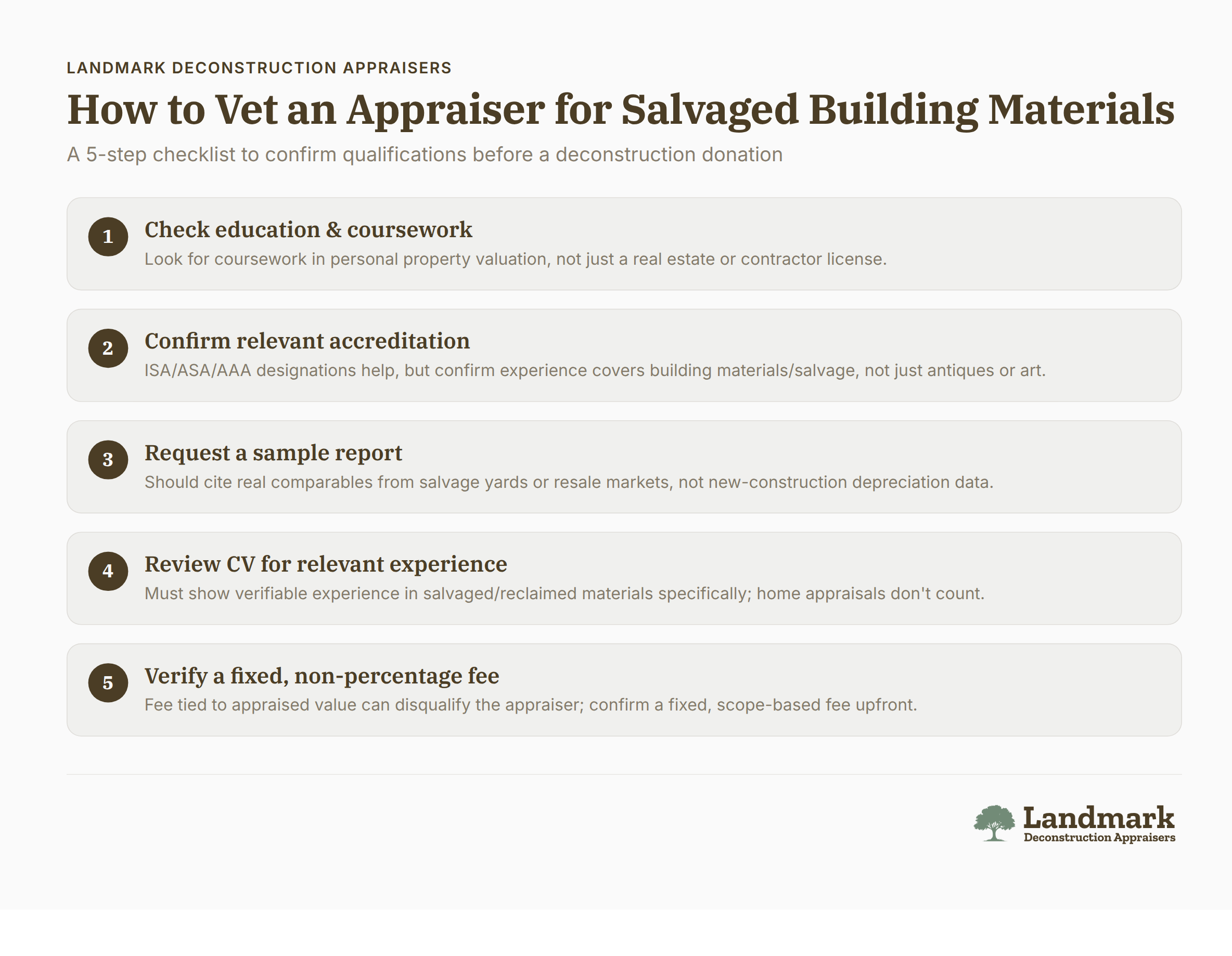
Before engaging an appraiser for a deconstruction donation, confirm their qualifications actually match the property type involved:
- Ask for documented education or coursework in personal property valuation. Look for completed coursework in appraisal theory and practice, not just a real estate license or a contractor's certification.
- Confirm relevant accreditation. Designations from organizations such as the ISA, ASA, or AAA signal formal training, but ask specifically whether the appraiser's experience covers used building materials and architectural salvage, not just antiques or fine art.
- Request a sample report with real secondary-market comparables. A credible report should cite actual sales or listings from salvage yards, reclaimed materials dealers, or resale marketplaces, not a depreciation percentage applied to new-construction cost data.
- Review a CV documenting relevant experience. The regulation requires verifiable experience in the specific property type; two years of appraising salvaged and reclaimed materials counts, two years of appraising single-family homes does not.
- Verify the fee is not tied to the appraised value. A percentage-of-value fee arrangement can disqualify an otherwise qualified appraiser, so confirm the engagement is a fixed, scope-based fee agreed before the appraisal begins.
Getting the Qualification Right the First Time
The appraiser's qualifications are not a formality on a deconstruction donation; they are often the exact issue an examiner checks first. Our team appraises deconstruction and architectural salvage donations specifically, documents the verifiable experience in reclaimed building materials that the regulation requires, and prepares USPAP-compliant reports built on real secondary-market comparables rather than cost-estimating shortcuts. Every engagement is quoted as a fixed fee once we understand the scope of the donation, never billed by the hour and never tied to the appraised value.
If you are planning a deconstruction project and want an appraiser whose background actually matches the materials coming out of the building, request an appraisal and tell us what the project involves.
This article is provided for general informational purposes only and does not constitute legal, tax, or financial advice. Readers should consult a qualified attorney or CPA regarding their specific circumstances.