
Blog
Do You Need a Qualified Appraisal for Building Material Donations Over $5,000?
A qualified appraisal becomes mandatory once your claimed deduction for donated building materials, whether one item or a group of similar items, crosses $5,000. This guide explains the aggregation rule, the required paperwork, and the penalties for skipping the appraisal.
A single reclaimed door rarely draws IRS attention on its own. Deconstruction projects, though, don't donate one door. They donate dozens of doors, hundreds of board feet of dimensional lumber, a full run of custom cabinetry, and a pallet of salvaged fixtures, all from one house, all in one tax year. Once the claimed deduction for any one of those categories crosses $5,000, whether from a single high-value piece or a pile of similar items added together, IRS Publication 526 requires a qualified appraisal prepared by a qualified appraiser before the deduction can be claimed. Our deconstruction donation appraisal service exists specifically to meet that requirement, and this guide walks through the threshold, the aggregation rule, the paperwork it demands, and what happens if a donor skips the appraisal and gets audited.
If you're still deciding whether your project even qualifies for a donation, our guide on how to donate deconstructed building materials and claim a tax deduction covers eligibility and the basic donation process before you get to the appraisal question.
The $5,000 Threshold: What Triggers a Qualified Appraisal Requirement
You need a qualified appraisal any time the claimed deduction for donated building materials, whether a single item or a group of similar items, exceeds $5,000. This rule applies to noncash property generally and covers building materials by default, since they are not cash, publicly traded securities, or one of the other narrow exceptions the IRS carves out.
The Instructions for Form 8283 confirm that donations over $5,000 must be reported in Section B of the form, which requires a written qualified appraisal signed by a qualified appraiser. Two additional dollar thresholds matter for larger deconstruction jobs:
- Over $500: Form 8283 must be filed with the return, even without a full appraisal.
- Over $5,000: a qualified appraisal and Form 8283 Section B are both required.
- Over $500,000: a complete copy of the signed appraisal must be physically attached to the return, not just kept on file, per IRS Publication 561.
Pro tip: Don't wait until tax season to figure out which threshold applies. Have the appraisal scoped while the deconstruction crew is still on site, since the appraiser needs accurate quantities and condition notes for every category being donated.
How the "Similar Items" Rule Aggregates Your Deconstruction Donation
The $5,000 threshold doesn't just apply item by item. It applies to "an item or a group of similar items," which means the IRS adds together everything in the same generic category before checking whether you've crossed the line.
"Similar items of property means property of the same generic category or type, such as stamp collections, coin collections, lithographs, paintings, photographs, books..." - IRS Publication 561
For a deconstruction donation, that means every door in the project counts together as one category, every run of dimensional lumber counts together, and every piece of custom cabinetry counts together, regardless of how many separate rooms, trucks, or drop-off dates were involved. A single 1920s craftsman home coming down might generate a donation that looks like this:
| Category | Items | Appraised Value |
|---|---|---|
| Custom cabinetry | Kitchen run, built-in bookshelves, bathroom vanity | $6,400 |
| Doors | 14 solid-core and paneled doors | $3,150 |
| Dimensional lumber | 2,400 board feet of reclaimed fir framing | $2,880 |
| Windows | 9 wood-frame double-hung units | $1,890 |
| Fixtures | Light fixtures, plumbing fixtures, hardware | $1,050 |
In this example, the cabinetry alone crosses $5,000 and requires a qualified appraisal on its own. The other categories fall under the threshold individually, but if the same donor contributes a second batch of doors or lumber from another project later in the same tax year, those donations get added to the running total for that category. A donor who assumes "none of my individual drop-offs hit $5,000" can still trigger the requirement once the IRS looks at the full-year aggregate for each category. 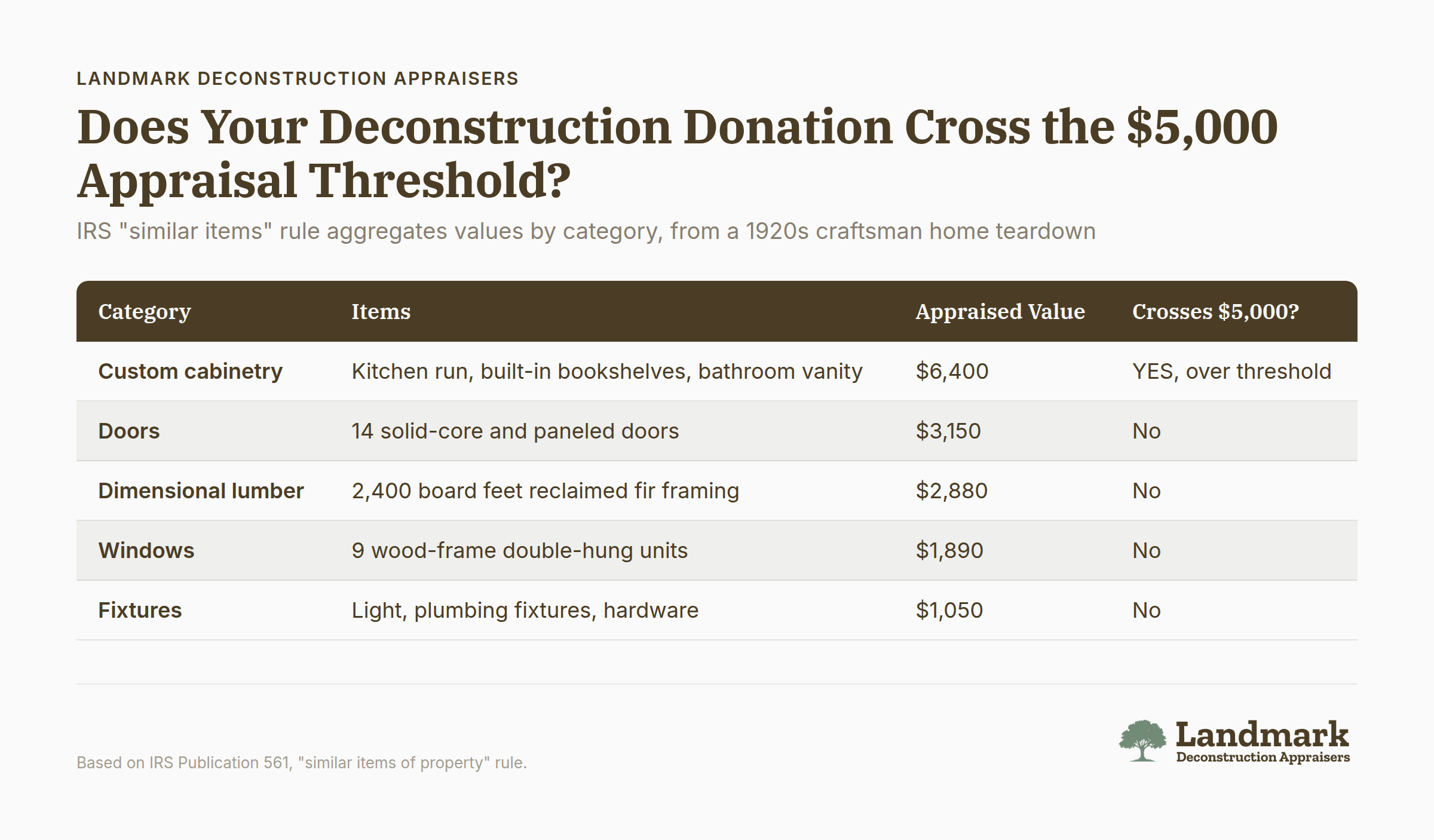
What a Qualified Appraisal and Form 8283 Require
Once a category crosses $5,000, three separate pieces of documentation need to line up: the appraisal itself, Form 8283, and an acknowledgment letter from the charity that received the materials.
The qualified appraisal must be signed and dated by a qualified appraiser, made no earlier than 60 days before the date of the contribution, and received before the due date (including extensions) of the return on which the deduction is first claimed, per the Form 8283 instructions. The report needs a detailed description of the property, its physical condition, the valuation method used, and the appraiser's qualifications.
Form 8283 Section B is filled out in stages: the donor describes the property and how it was acquired, the appraiser signs a declaration, and the receiving nonprofit acknowledges the donation on the same form. Missing any one of these signatures is treated the same as not having the form at all.
The contemporaneous written acknowledgment (CWA) comes separately, from the charity itself. The IRS's guidance on substantiating noncash contributions is explicit that the donee organization cannot serve as the qualified appraiser. Its job is limited to describing what it received and confirming whether the donor got anything of value in return, not putting a dollar figure on the materials.
Watch out: A CWA from the ReStore, a habitat affiliate, or another receiving nonprofit is not a substitute for the appraisal. It documents that the donation happened; it does not establish fair market value.
What Happens if You Skip the Appraisal and Get Audited?
Skipping the appraisal doesn't just create a documentation gap. It puts the entire deduction at risk. If a donor claims a deduction over $5,000 without a qualified appraisal and the IRS examines the return, the deduction can be disallowed outright for failing to meet the statutory requirement, regardless of whether the claimed value was actually reasonable.
Even when a donor does obtain an appraisal, an inflated valuation carries its own exposure. Under the tax code's accuracy-related penalty provisions, a substantial valuation misstatement (claiming a value that's 150% or more of the correct value) triggers a 20% penalty on the resulting underpayment. A gross valuation misstatement (claiming 200% or more of the correct value) doubles that to 40%. These penalties apply on top of the tax owed once the correct value is determined, not instead of it. 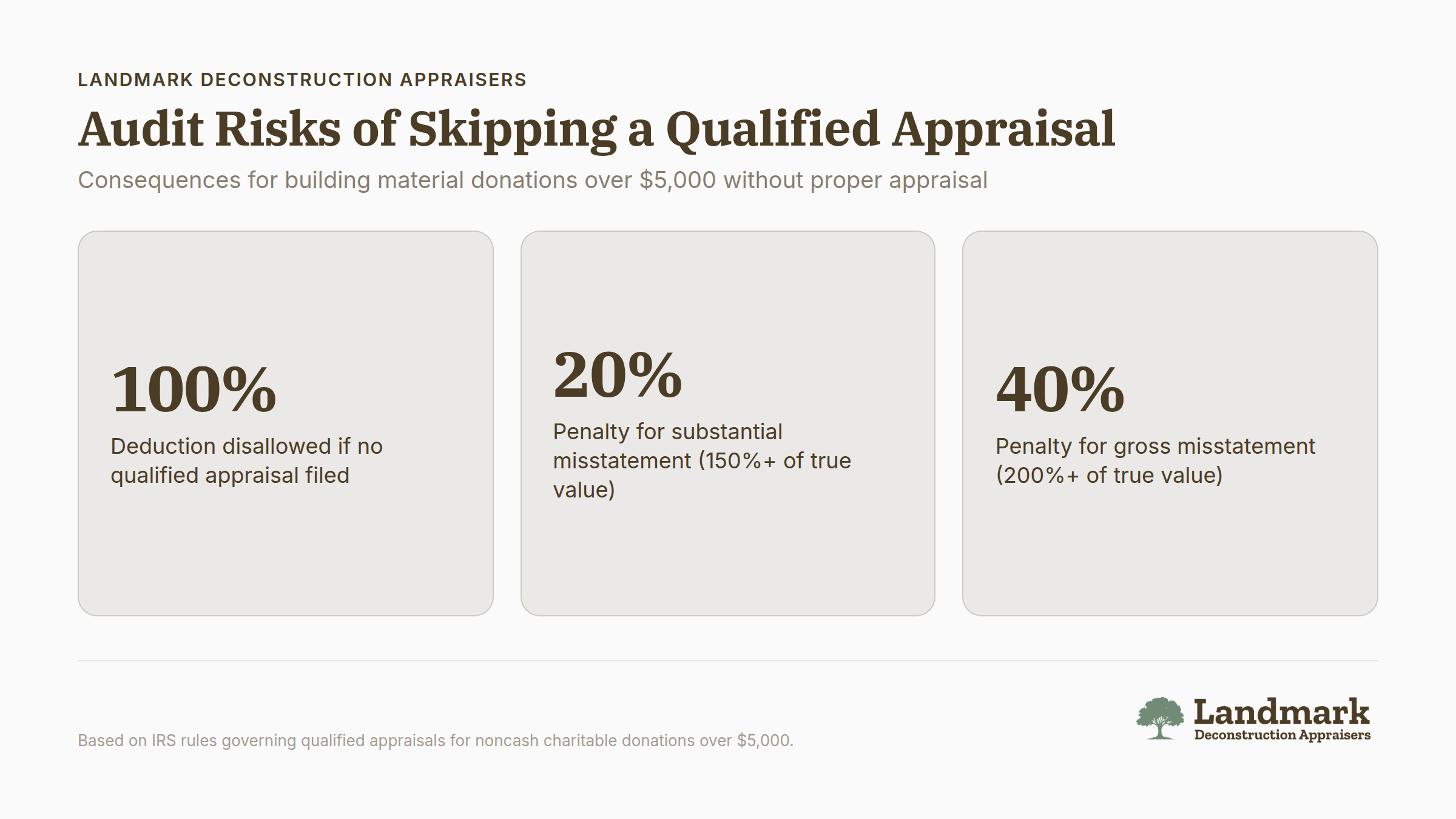
This is why the appraiser's methodology matters as much as the final number. An appraisal built on comparable sales, documented condition, and a defensible valuation approach for each category holds up far better under review than a rough estimate padded to maximize the deduction.
Documentation Checklist Before You File
Before claiming a deduction for a deconstruction donation over $5,000, confirm that you have all of the following in hand:
- A qualified appraisal signed and dated by a qualified appraiser, completed within the required 60-day to filing-deadline window.
- Form 8283 Section B, with the donor description, appraiser declaration, and donee acknowledgment all completed.
- A contemporaneous written acknowledgment from the receiving nonprofit describing the property and any goods or services exchanged.
- Category-by-category valuations that show how doors, lumber, cabinetry, windows, and fixtures were aggregated and appraised, so the IRS can see the full picture, not just a lump-sum total.
Get the Appraisal Before You Claim the Deduction
The $5,000 threshold is easy to underestimate on a deconstruction project because no single door or window looks like a $5,000 asset. Once the IRS groups similar items together, though, cabinetry, doors, and reclaimed lumber routinely cross that line, and the paperwork requirement follows automatically. Getting the appraisal, the Form 8283 signatures, and the donee acknowledgment in place before you file protects the deduction you're counting on.
If your project is generating enough salvaged material to approach these thresholds, request an appraisal before you finalize the donation so the valuation and paperwork are ready when you file.
This article is provided for general informational purposes only and does not constitute legal, tax, or financial advice. Readers should consult a qualified attorney or CPA regarding their specific circumstances.