
Blog
How to Complete Form 8283 for a Building Materials Donation Over $5,000
Donating deconstructed building materials worth more than $5,000 means filing Section B of Form 8283, correctly split between donor, appraiser, and donee signatures. This guide walks through every part of the form and the mistakes that draw IRS scrutiny.
Deconstruction donors routinely leave real money on the table, or worse, lose the deduction entirely, because Form 8283 gets filled out incorrectly. When a homeowner or contractor donates cabinetry, doors, lumber, fixtures, and architectural salvage from a deconstruction project, the claimed deduction often crosses the $5,000 threshold that triggers a qualified appraisal and a fully completed Section B. This guide walks through exactly who fills out which part of the form, why building materials get appraised as personal property rather than real estate, and the filing mistakes that most often draw IRS attention.
Our deconstruction donation appraisal services prepare the qualified appraisal and complete the appraiser's portion of Form 8283 for donors across the country, so we see the same handful of errors again and again. Most of them are avoidable with a little planning before the demolition crew even shows up.
What Triggers Form 8283 for a Building Materials Donation?
Form 8283 is required whenever a taxpayer's total noncash charitable deduction for the year exceeds $500, according to the IRS Instructions for Form 8283. For a single item or a group of similar items, the deduction amount determines which section of the form applies.
- $500 to $5,000: Complete Section A only. No appraisal is required.
- More than $5,000: Complete Section B, which requires a qualified appraisal and signatures from the appraiser and the donee organization.
- More than $500,000: Attach a full copy of the qualified appraisal to the return, not just the completed form.
A full deconstruction, where a contractor strips cabinetry, doors, trim, lumber, plumbing fixtures, and architectural salvage from a single structure, almost always lands well above $5,000 once every category is combined. That's the point at which Section B and a qualified appraisal stop being optional. We covered how that threshold specifically applies to salvaged material in our guide to the $5,000 appraisal threshold for building materials.
Section A vs. Section B: Where Does Your Donation Go?
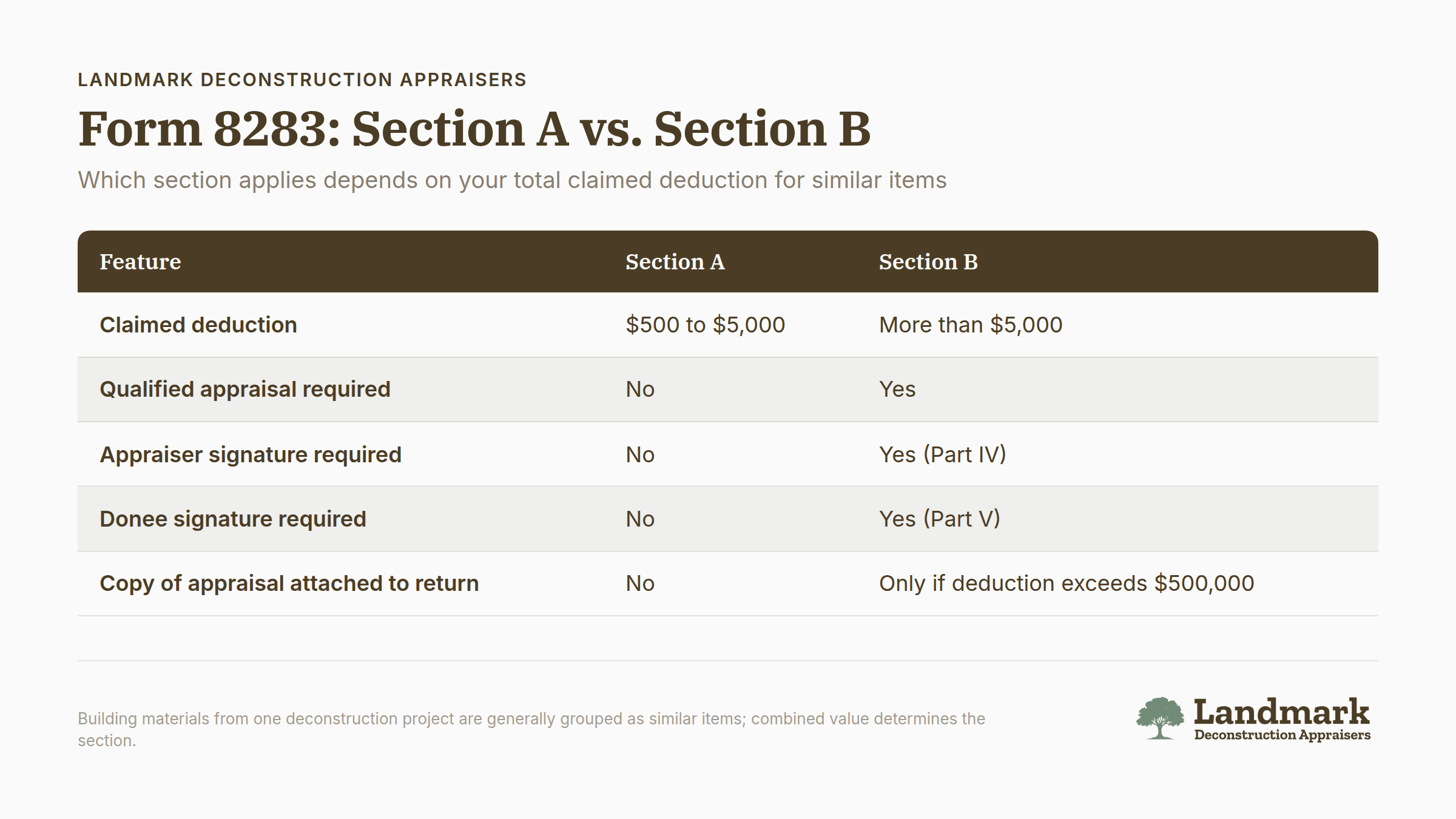
The fastest way to know which section applies is to total the claimed deduction for each group of similar items donated to the same organization in the same tax year. Building materials from one deconstruction project (cabinetry, doors, flooring, fixtures, salvaged lumber) are generally treated as a single similar-items group for this purpose, so their combined value, not any single board or cabinet, is what matters.
| Feature | Section A | Section B |
|---|---|---|
| Claimed deduction | $500 to $5,000 | More than $5,000 |
| Qualified appraisal required | No | Yes |
| Appraiser signature required | No | Yes (Part IV) |
| Donee signature required | No | Yes (Part V) |
| Copy of appraisal attached to return | No | Only if deduction exceeds $500,000 |
Who Completes Each Part of Section B?
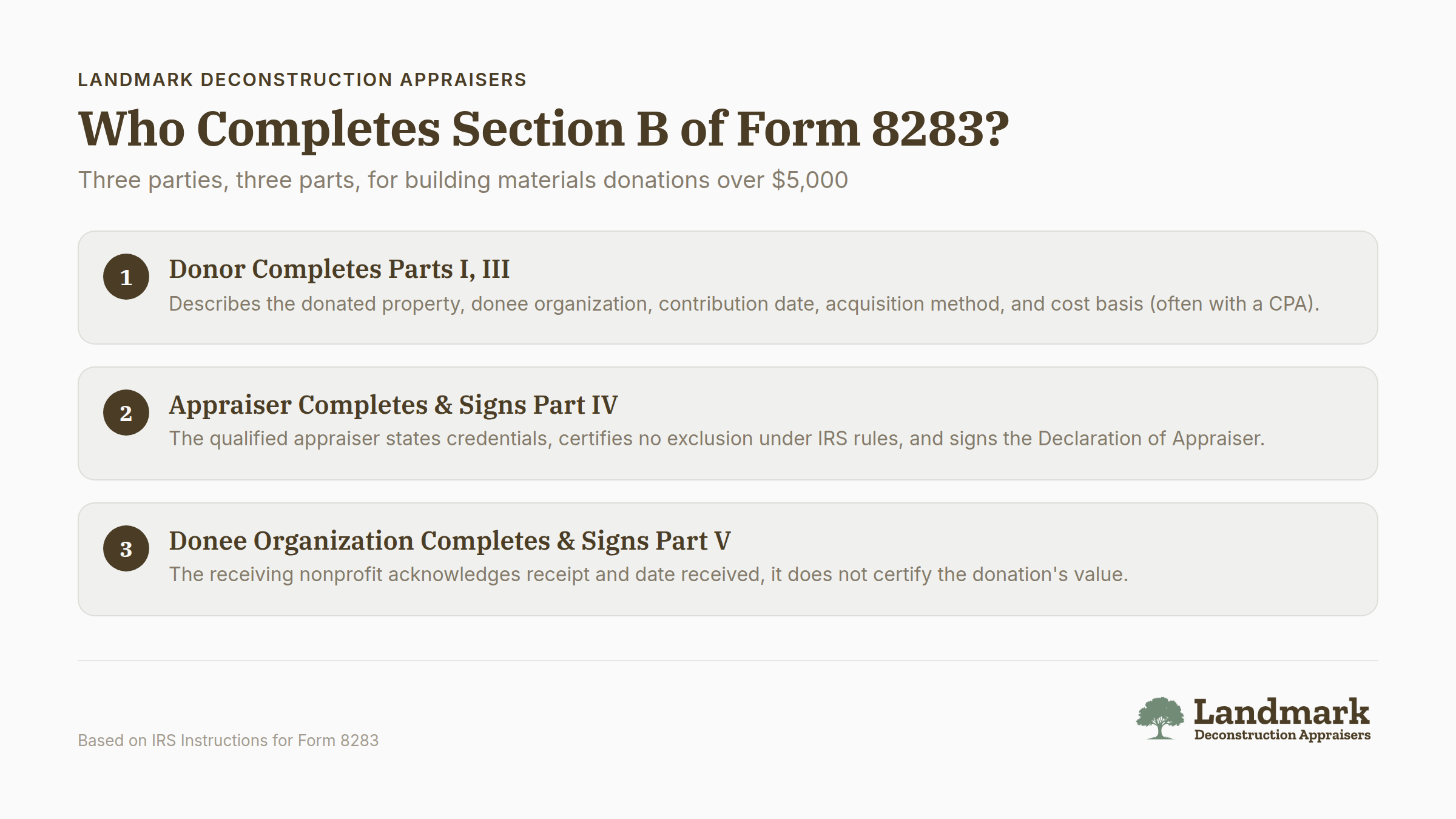
Section B of Form 8283 has five parts, and no single party fills out the whole thing. Confusion over who signs what is one of the most common reasons deconstruction donors end up with an incomplete form.
- Donor Completes Parts I Through III
- The donor (often working with a CPA) describes the donated property, the donee organization, the date of the contribution, and how the property was acquired and its cost basis.
- This is where the deconstruction project gets described: address of the structure, categories of material donated, and the date the materials were physically removed and delivered to the donee.
- The Qualified Appraiser Completes and Signs Part IV
- Part IV is the Declaration of Appraiser. The appraiser states their qualifications, certifies they are not an excluded party under the IRS rules, and signs and dates the declaration.
- At Landmark Deconstruction Appraisers, our team prepares the qualified appraisal report and completes this section directly, so the donor never has to guess what the appraiser's declaration should say.
- The Donee Organization Completes and Signs Part V
- The receiving nonprofit (a Habitat for Humanity ReStore, a salvage nonprofit, or another qualified charity) acknowledges receipt of the property and the date it was received.
- This signature does not certify the value of the donation. It only confirms the organization received the property described.
"A separate qualified appraisal and a separate Form 8283 are required for each item of property except for an item that is part of a group of similar items. Only one appraisal is required for a group of similar items contributed in the same tax year, if it includes all the required information for each item." - IRS Instructions for Form 8283
Pro tip: Send the donor's completed Parts I through III to your appraiser before the appraisal report is finalized. It's far easier for the appraiser to match Part IV language to an accurate donor description than to reconcile mismatched dates or addresses after the fact.
The $5,000 Threshold and the Similar Items Aggregation Rule
A deconstruction donation rarely consists of one item. It's cabinetry, interior doors, hardwood flooring, plumbing fixtures, light fixtures, and dimensional lumber, all pulled from the same structure and donated to the same organization on roughly the same date. The IRS treats these as a group of similar items for purposes of the $5,000 threshold, which means the combined claimed value across every category determines whether Section B applies, not the value of any individual door or cabinet.
This cuts both ways. It means a donor can't avoid the appraisal requirement by claiming each category separately if the categories were all donated together. It also means one qualified appraisal report can cover the entire deconstruction, as long as it includes all the information required for each item within the group.
Watch out: If the same donor gives building materials to more than one donee organization during the year and the deduction to each donee exceeds $5,000, a separate Form 8283 is required for each donee. Combining a ReStore donation and a separate salvage nonprofit donation on one form is a common but incorrect shortcut.
Why Building Materials Are Appraised as Personal Property, Not Real Estate
Here's a distinction that trips up a lot of first-time deconstruction donors: once cabinetry, doors, fixtures, lumber, and architectural salvage are detached from the structure, they stop being real property and become personal property for valuation purposes. A kitchen cabinet still attached to a wall is part of the house. The same cabinet, pulled and stacked on a pallet for donation, is now a discrete, movable asset with its own resale market.
That distinction matters because a real-property appraisal (the kind used for mortgages or property tax assessments) values land and structures using comparable sales of similar buildings. It has nothing to say about what a salvaged Douglas fir door or a set of custom cabinets is worth on the reclaimed materials market. A qualified appraisal for a building materials donation has to use personal property valuation methodology, looking at resale markets for architectural salvage, reclaimed lumber, and used fixtures, not real estate comparables.
Key takeaway: If your appraisal report reads like a real estate appraisal, with comparable home sales and square footage adjustments, it's the wrong report for a Form 8283 building materials donation, and the IRS is likely to reject it as insufficient support for the deduction.
Common Filing Mistakes That Trigger IRS Scrutiny
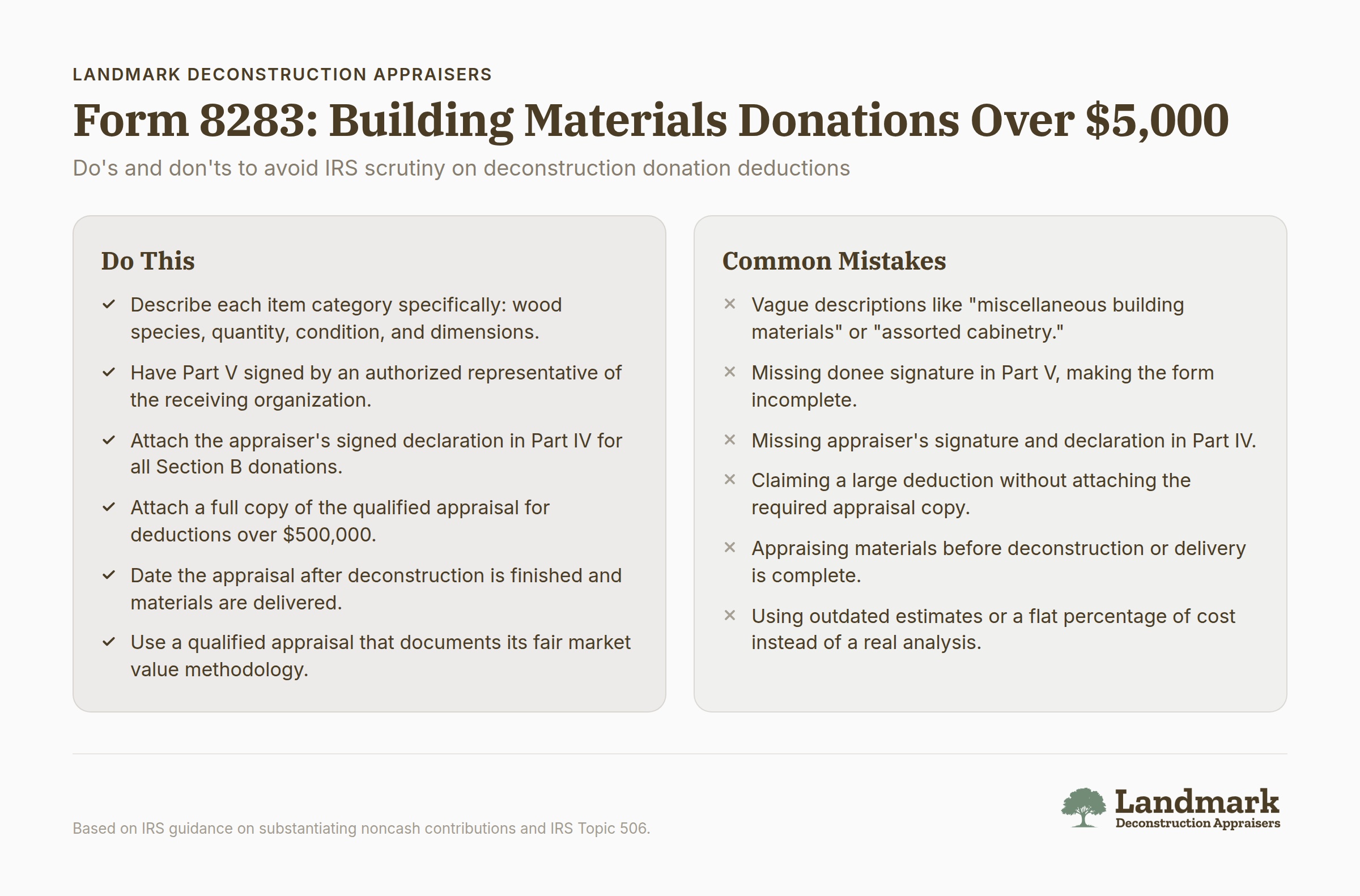
Most Form 8283 problems on deconstruction donations trace back to a small set of recurring errors:
- Vague item descriptions. "Miscellaneous building materials" or "assorted cabinetry" does not meet the description standard. Each category needs enough specificity (species of wood, approximate quantity, condition, general dimensions) that a reviewer can connect the description to the appraisal report.
- Missing the donee signature. Part V has to be signed by an authorized representative of the receiving organization. A form submitted without it is treated as incomplete, and the IRS guidance on substantiating noncash contributions makes clear that incomplete substantiation puts the deduction at risk.
- Missing the appraiser's signature and declaration. Part IV is not optional for any Section B donation. A donor who tries to submit an appraisal report without the signed declaration attached to the form is missing a required element.
- Claiming a large deduction without attaching the appraisal. Deductions over $500,000 require a full copy of the qualified appraisal to be attached to the return, not just the summary form, per IRS Topic 506.
- Appraising materials before the donation is complete. An appraisal dated before the deconstruction is finished, or before the materials are actually delivered to the donee, does not reflect the property as it existed on the date of contribution. The appraisal date needs to align with the completed removal and transfer of the materials.
- Using outdated or generic value estimates instead of a documented fair market value analysis. A qualified appraisal has to show the methodology behind the number, not a flat percentage of original cost or a contractor's rough estimate.
Getting the Timing and Signatures Right the First Time
A deconstruction donation over $5,000 involves three separate parties on one form: the donor's tax information, the appraiser's certified valuation and declaration, and the donee's acknowledgment of receipt. Each piece has to be accurate, dated correctly, and signed by the right person before the return is filed. Missing any one of the three is enough to put the deduction in question.
Our team at Landmark Deconstruction Appraisers prepares the qualified appraisal report and completes Part IV directly, and we routinely coordinate with donors' CPAs to make sure Parts I through III line up with the appraisal before the donee ever signs Part V. If you're planning a deconstruction donation and want the paperwork handled correctly from the start, you can request an appraisal and we'll walk you through what documentation to gather before the crew starts pulling materials.
This article is provided for general informational purposes only and does not constitute legal, tax, or financial advice. Readers should consult a qualified attorney or CPA regarding their specific circumstances.