
Blog
Can You Deduct Demolition Costs and Labor Along With Donated Materials?
No, you cannot deduct demolition, hauling, or labor costs as part of a building materials donation. Only the fair market value of the materials themselves qualifies, and this guide shows exactly how that number is calculated and documented.
Homeowners who deconstruct a kitchen, a bathroom, or an entire structure before donating the salvageable materials often assume the whole project cost counts toward their charitable deduction. It doesn't. The IRS draws a hard line between the value of the materials you actually give away and the money you spent getting them out of the building, and that line trips up more donors than almost any other rule in this space.
This matters because the gap between what people expect to deduct and what they're actually entitled to can be enormous. A renovation with expensive labor and modest material value can leave a donor thinking they earned a five-figure deduction when the real number is a fraction of that. Understanding the rule before you start tearing out cabinets saves you from an unpleasant surprise at tax time, and from an appraisal that comes back lower than the contractor's invoice.
The Common Misconception: One Project, One Deduction
The mistake usually sounds something like this: "We paid $20,000 to have the kitchen deconstructed and donated instead of demolished, so we should be able to deduct $20,000." It's an understandable assumption. The homeowner spent real money, the materials went to a nonprofit instead of a landfill, and the whole project was framed around the donation from the start.
But the IRS doesn't see a renovation invoice. It sees two separate transactions: a service you purchased (deconstruction labor, hauling, disposal) and a gift you made (the materials themselves, once they left your possession and landed with a qualified organization). Only the second transaction is a charitable contribution. IRS Publication 561 values donated property based on what a willing buyer would pay a willing seller for the item as it exists on the date of the gift, not on what it cost you to reach that point.
What the IRS Actually Lets You Deduct
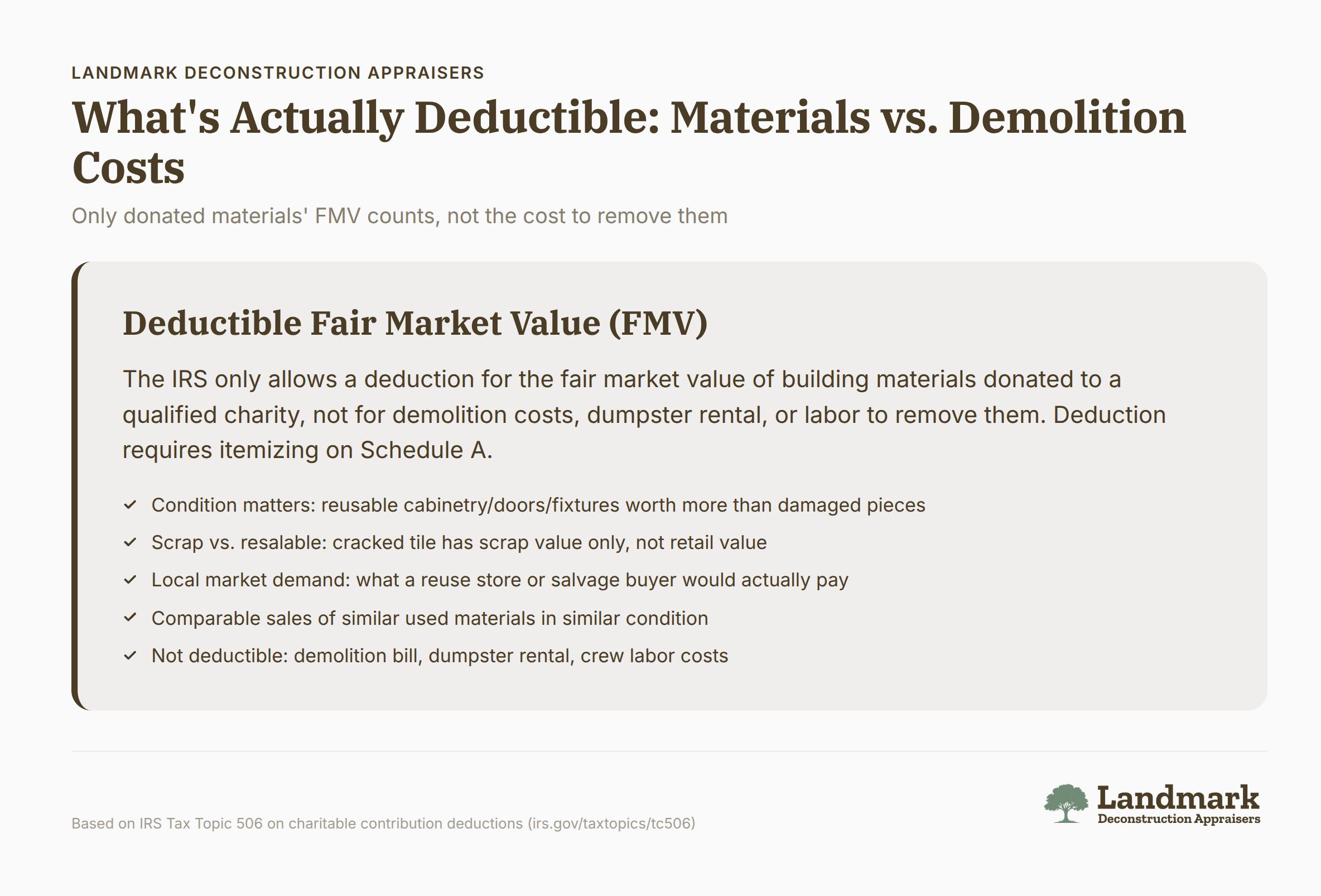
Only the fair market value (FMV) of the materials transferred to a qualified charity is deductible, and only if you itemize. The deduction is calculated on the condition and market value of the materials as donated, not on the demolition bill, the dumpster rental, or the crew's hourly rate.
That FMV determination pulls in several factors our fair market value guide for salvaged materials covers in more depth:
- Condition of the materials: reusable cabinetry, doors, and fixtures hold more value than cracked or water-damaged pieces.
- Whether items are scrap or resalable: a stack of cracked tile has scrap value at best, not retail value.
- Local market demand: what a reuse store or salvage buyer in your area would actually pay.
- Comparable sales: recent sales of similar used materials in similar condition.
- Quantity and separability: whether the materials can be sold as a matched set or only piecemeal.
Deductions like this are only available to taxpayers who itemize on Schedule A, a point the IRS's general guidance on charitable contribution deductions confirms applies across all noncash gifts, not just building materials.
Demolition, Hauling, and Labor: Why These Costs Don't Count
Demolition, transportation, dumpster fees, and contractor labor are payments for services, not gifts to a charity, so none of them are deductible as part of the donation. You paid a contractor to do work for you. The charity never received that money, and it never received the labor itself as property, so there's nothing to value as a contribution.
This distinction was tested directly in court. In a case examined by The Tax Adviser, a federal appeals court upheld the disallowance of a deduction based on the full pre-deconstruction value of a house's components, drawing a clear separation between the materials actually recovered and donated and the homeowner's separate, non-charitable obligation to pay for demolition work. The ruling reinforced that a donor cannot back into a large deduction simply because deconstruction, rather than demolition, made the donation possible.
The same logic applies to your own labor. If you personally spent a weekend removing cabinets and doors, the value of your time is never deductible. Only unreimbursed, documented out-of-pocket expenses directly tied to the donation may qualify, and even those are a narrow category separate from the materials' FMV.
Worked Example: $20,000 in Labor vs $8,000 in Materials
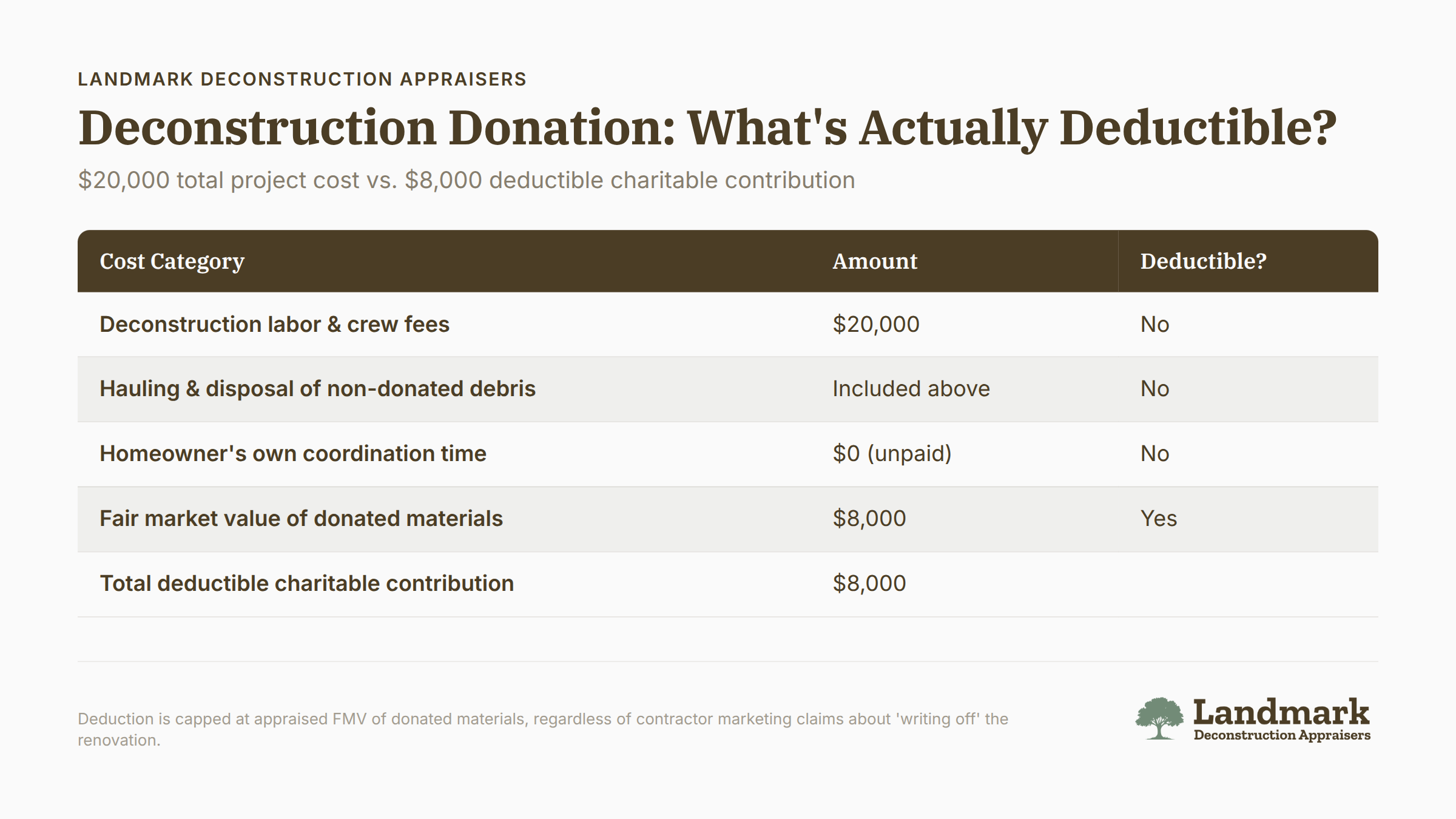
Example: A homeowner hires a deconstruction crew to carefully remove a kitchen before a full remodel. The crew charges $20,000 for the careful removal, hauling, and disposal of non-donated debris. The recovered cabinets, countertops, and appliances are donated to a qualified nonprofit reuse organization, which issues an itemized donation receipt. An independent appraisal values those materials, in their as-removed condition, at $8,000.
| Cost Category | Amount | Deductible? |
|---|---|---|
| Deconstruction labor and crew fees | $20,000 | No |
| Hauling and disposal of non-donated debris | Included above | No |
| Homeowner's own time coordinating the project | $0 (unpaid) | No |
| Fair market value of donated materials | $8,000 | Yes |
| Total deductible charitable contribution | $8,000 |
The homeowner's total out-of-pocket project cost was $20,000. The deductible charitable contribution is $8,000, the appraised FMV of the materials on the date they were donated. The $12,000 difference reflects labor and services the homeowner purchased for themselves, not property given to the charity.
Watch out: Some contractors market deconstruction as a way to "write off" the renovation. That framing is misleading. The deduction is capped at the materials' FMV, full stop, regardless of how the marketing describes the project.
Why the $5,000 Threshold Still Triggers a Qualified Appraisal
Even though the deductible amount in the example above is well under the full project cost, it can still cross the appraisal threshold on its own. Under the general noncash contribution rules, once the claimed deduction for an item or group of similar items exceeds $5,000, the donor must obtain a qualified appraisal from a qualified appraiser and attach Form 8283 to the tax return. Our guide to the $5,000 threshold for building materials walks through how similar items get aggregated for this purpose, which matters when a donation includes cabinetry, flooring, fixtures, and trim from the same project.
For gifts over $250, a contemporaneous written acknowledgment from the receiving nonprofit is required regardless of the dollar amount, per IRS guidance on substantiating charitable contributions. Completing Form 8283 correctly, including the appraiser's signature and the required property description, is its own process, which our Form 8283 guide for building material donations covers step by step.
A qualified appraisal for donated building materials is prepared in accordance with USPAP (Uniform Standards of Professional Appraisal Practice, published by The Appraisal Foundation) and reflects the standards personal property appraisers follow, credentials such as the ISA, ASA, and AAA among them. The appraisal values the materials as personal property, separate from the real property they came out of. A set of salvaged cabinets is worth what a buyer would pay for used cabinets in that condition, not a proportional share of the house's assessed value.
When the Appraisal Clock Starts
Appraisal work on donated building materials doesn't begin until deconstruction is finished and the materials are physically transferred to the nonprofit with an itemized donation receipt. An appraiser can't assign a fair market value to cabinets still bolted to a wall or countertops still attached to a base. The materials have to exist as discrete, removed items before anyone can compare them to similar sales or assess their condition.
In practice, this means the sequence runs: deconstruction completes, materials are sorted and delivered to the receiving organization, the nonprofit issues an itemized receipt describing what it received, and only then does the appraisal assignment begin. Fees for a personal property appraisal of this kind are quoted as a fixed fee after the scope is set, based on the number of items, the completeness of the donation records, and whether the report needs to meet the IRS-qualified appraisal standard. Fees are never based on a percentage of the appraised value, and they're never billed by the hour.
Keeping the Deduction Defensible
The rule is simple even when the paperwork isn't: your deduction is the fair market value of what you gave away, not the cost of getting it out of the building. Homeowners who plan for this distinction before deconstruction begins, by getting an itemized receipt from the receiving nonprofit and lining up a qualified appraisal for anything likely to exceed $5,000, end up with a return that holds up if it's ever questioned. Homeowners who assume the full invoice is deductible usually find out otherwise the hard way.
If you're planning a deconstruction project and want the materials donation documented correctly from day one, our team can scope a qualified appraisal built around your project's timeline and the receiving organization's requirements.
This article is provided for general informational purposes only and does not constitute legal, tax, or financial advice. Readers should consult a qualified attorney or CPA regarding their specific circumstances.