
Blog
How to Donate Deconstructed Building Materials and Claim a Tax Deduction
Donating deconstructed lumber, cabinets, doors, and fixtures to a qualified reuse organization can unlock a real tax deduction, but only if the donation, receipt, and appraisal happen in the right order. This guide walks homeowners through the $5,000 qualified appraisal threshold, Form 8283 Section B, and the sequencing rules that protect a building materials donation deduction.
If you're gutting a kitchen, tearing off a roof, or taking a house down to the studs before a rebuild, the materials coming out of that structure have real value. Cabinets, doors, windows, flooring, brick, and clean dimensional lumber can go to a qualified reuse organization instead of a dumpster, and that donation can become a legitimate charitable deduction. The catch is that the IRS cares as much about how and when you document the donation as it does about what you actually gave away.
This guide walks through the process in order: what qualifies, how to document it, when a qualified appraisal is required, and why the paperwork has to happen in a specific sequence. If you're not sure whether your project needs a formal valuation at all, our deconstruction donation appraisal services team can help you scope that before you start pulling materials out of the house.
What Building Materials Qualify for Donation?
Most reuse organizations accept building components in genuinely reusable condition, not construction debris. Habitat for Humanity ReStores, for example, commonly take kitchen cabinets, doors and windows, flooring, unused lumber, lighting fixtures, fencing, and bricks or blocks, provided they're intact and functional, as outlined in Habitat for Humanity's donation guidance.
Regional reuse centers get more specific. Big Reuse in New York City, for instance, accepts dimensional lumber longer than 6 feet, full sheets of plywood or MDF, palletized bricks and pavers, hardwood flooring in quantities of 500 square feet or more, and multiple door and window types, while explicitly rejecting vinyl siding, sheetrock, hollow-core doors, and storm windows, according to Big Reuse's material acceptance list. Every reuse organization publishes its own list, so it pays to check before you load the truck. Our page on where you can donate construction materials has more detail on finding a reuse partner near you.
Watch out: Asbestos, lead paint, and other hazardous materials are excluded almost everywhere. If your teardown involves anything built before 1978, have it inspected before deconstruction begins, not after.
Step 1: Deconstruct Before You Donate
Deconstruction means selectively dismantling a structure so components come out intact, rather than demolishing and sorting scrap afterward. This distinction matters for both the reuse organization and your tax deduction: a demolished pile of mixed debris has no resale value and won't be accepted, while carefully removed cabinets, trim, and flooring retain the market value your deduction depends on.
Plan the teardown sequence around what you intend to donate. Doors and windows generally need to come out before framing work begins. Cabinets and fixtures should be removed as complete units where possible rather than pried apart.
Step 2: Inventory and Photograph Everything Before It Leaves the Site
Build a detailed list as materials come out: quantities, dimensions, lumber species, fixture manufacturers, and condition notes. This inventory does double duty. It supports the eventual appraisal, and it backs up the written acknowledgment you'll need from the receiving nonprofit.
Photograph materials twice: once in place before removal, and again after salvage but before you hand them off, and keep those photos with your donation receipt as part of your substantiation file. A dated visual record of what you gave and its condition is exactly the kind of documentation your eventual appraisal relies on. Reuse centers accept items at staff discretion and publish their own donation guidelines, so confirm the receiving organization's current requirements before you load the truck, as Boston Building Resources' donation guidelines illustrate.
Pro tip: Keep a simple spreadsheet as you go, room by room. Trying to reconstruct an inventory from memory after the dumpster is gone is where most donors lose deduction value.
Step 3: Choose a Qualified Reuse Organization and Get Your Donee Receipt
Organizations like Habitat ReStores, Big Reuse, and regional reuse centers such as the Lifecycle Building Center in Atlanta accept material donations from active deconstruction projects, often with a drop-off request form or a scheduled pickup window, per Lifecycle Building Center's material donation program. Most centers ask larger donors or active deconstruction projects to coordinate in advance rather than showing up unannounced with a truckload.
Whatever organization you choose, get a written, contemporaneous acknowledgment describing what you donated. This receipt is required by the IRS for any single donation over $250, and it's the document your eventual appraisal will reference, not the other way around.
Step 4: Determine Whether You Need a Qualified Appraisal
If the claimed value of your building materials donation exceeds $5,000, federal tax law requires a qualified appraisal prepared by a qualified appraiser before you can claim the deduction. This threshold comes from IRC 170(f)(11)(E), and it applies whether the donated property is a single high-value item or an aggregated group of similar building materials donated in the same tax year.
The fair market value standard behind that appraisal is well established:
"Fair market value is the price at which the property would change hands between a willing buyer and a willing seller, neither being under any compulsion to buy or sell and both having reasonable knowledge of relevant facts." - as applied to deconstructed building materials in The Green Mission's donor guidance on charitable deductions
Donations of salvaged building materials are generally treated as tangible personal property, which is typically subject to a 50% of adjusted gross income limitation for deductibility, and homeowners planning larger deconstruction projects in 2026 should also watch for new AGI floor and top-bracket limitation rules affecting non-cash charitable contributions. The IRS publishes current guidance on non-cash contribution rules and Form 8283 requirements at IRS.gov.
Why the Appraisal Comes After the Donation, Not Before
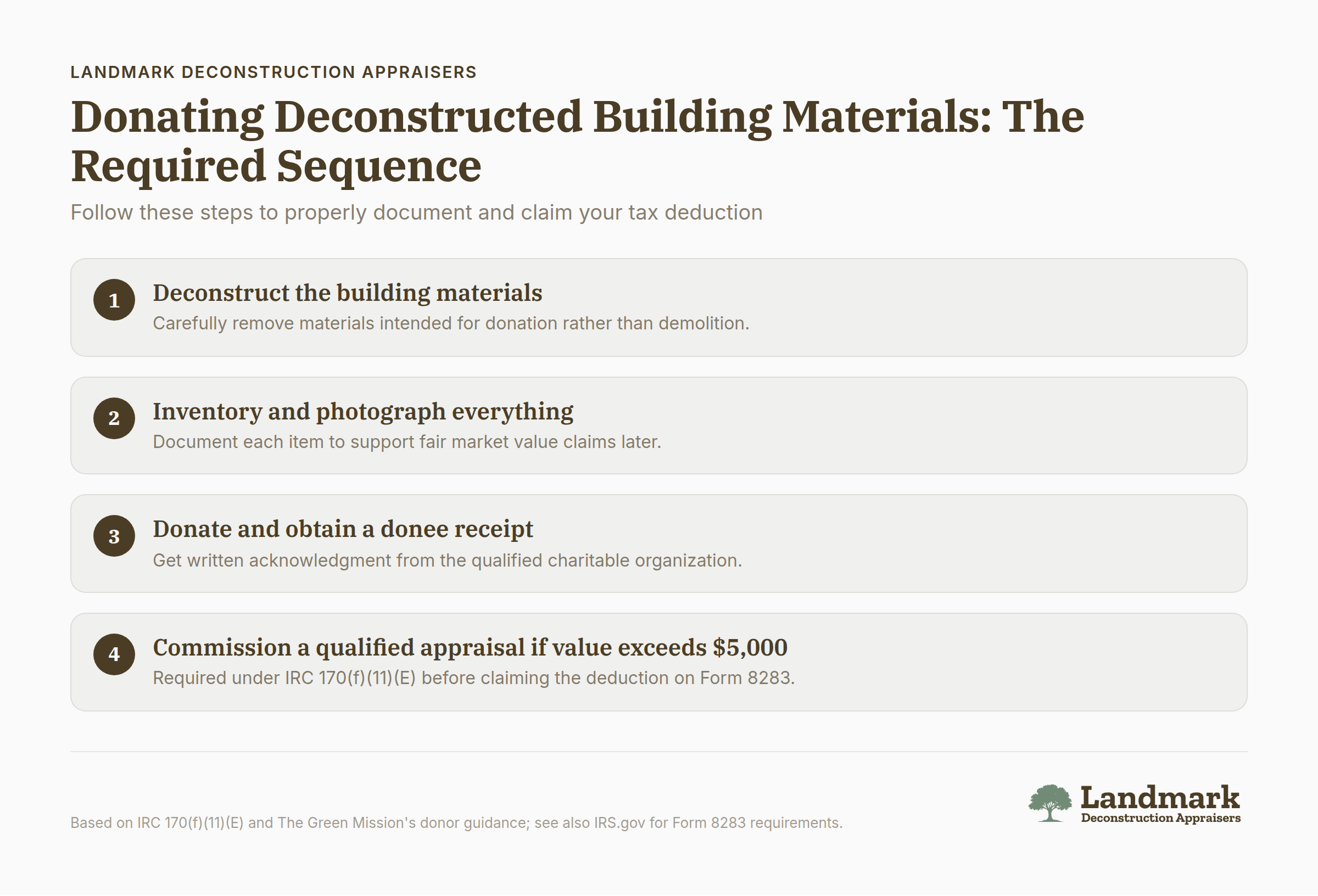
This trips up a lot of first-time donors: the qualified appraisal is not something you get quoted before you decide to donate. It has to be based on the actual materials as donated, dated appropriately relative to the donation itself, and it relies on the donee's written receipt describing what was actually received.
In practice, that means the order runs: deconstruct, inventory and photograph, donate and receive the acknowledgment from the nonprofit, and only then commission the qualified appraisal. An appraiser working from your inventory and the donee receipt can then value the materials as of the date they changed hands, which is what the IRS requires and what a defensible report depends on.
Key takeaway: The appraisal documents a completed donation, it doesn't estimate a hypothetical one. Skipping straight from demolition to an appraisal request, without a donee receipt in hand, is one of the more common reasons a donor's substantiation falls apart under review.
Form 8283 Section B: What the IRS Wants to See
When your building materials donation exceeds $5,000, you'll file Form 8283 Section B along with your tax return. Section B requires a description of the donated property, the appraiser's qualifications and signature, and the donee organization's acknowledgment of receipt on the same form.
A few things the IRS looks for in that section:
- A clear property description: quantities, materials, and condition, matching the inventory you built during deconstruction.
- The appraiser's signed declaration: confirming they meet the qualified appraiser standard and have no prohibited relationship to the donation.
- The donee's signature acknowledging receipt: which is why the written acknowledgment from Step 3 has to exist before this form can be completed.
- The date of contribution: which anchors the fair market value determination the appraisal relies on.
The Contingent-Fee Rule Every Appraiser Must Follow
A qualified appraisal cannot be prepared for a fee that depends on the appraised value or on whether the deduction is allowed. This is a hard rule under federal tax law, not a professional courtesy. An appraiser paid a percentage of the claimed deduction, or paid only if the IRS accepts the value, disqualifies the appraisal entirely, regardless of how accurate the number turns out to be.
When you engage an appraiser for a building materials donation, expect a fixed fee agreed to before the work begins, unrelated to the value the appraiser ultimately concludes.
What a Building Materials Donation Appraisal Costs
Because deconstructed building materials are treated as tangible personal property for donation purposes, they're priced the same way any personal property appraisal is: as a fixed fee scoped to the assignment, never as a percentage of value. For a donation that needs to be IRS-qualified under Section 170(f)(11)(E), that engagement generally starts from $295, with most single-project donations (a kitchen's worth of cabinets, a set of salvaged doors and windows, a run of hardwood flooring) landing between $395 and $2,200 depending on the volume and variety of materials involved.
What drives that fee is scope, not the dollar value of the materials themselves: how many categories of material you're donating, how complete your inventory and photographs are, and how much research the appraiser needs to do to support fair market value for each category. A messy, undocumented pile of salvage takes longer to appraise than a clean, well-photographed inventory organized by material type.
Quick Reference: What Reuse Organizations Accept and Reject
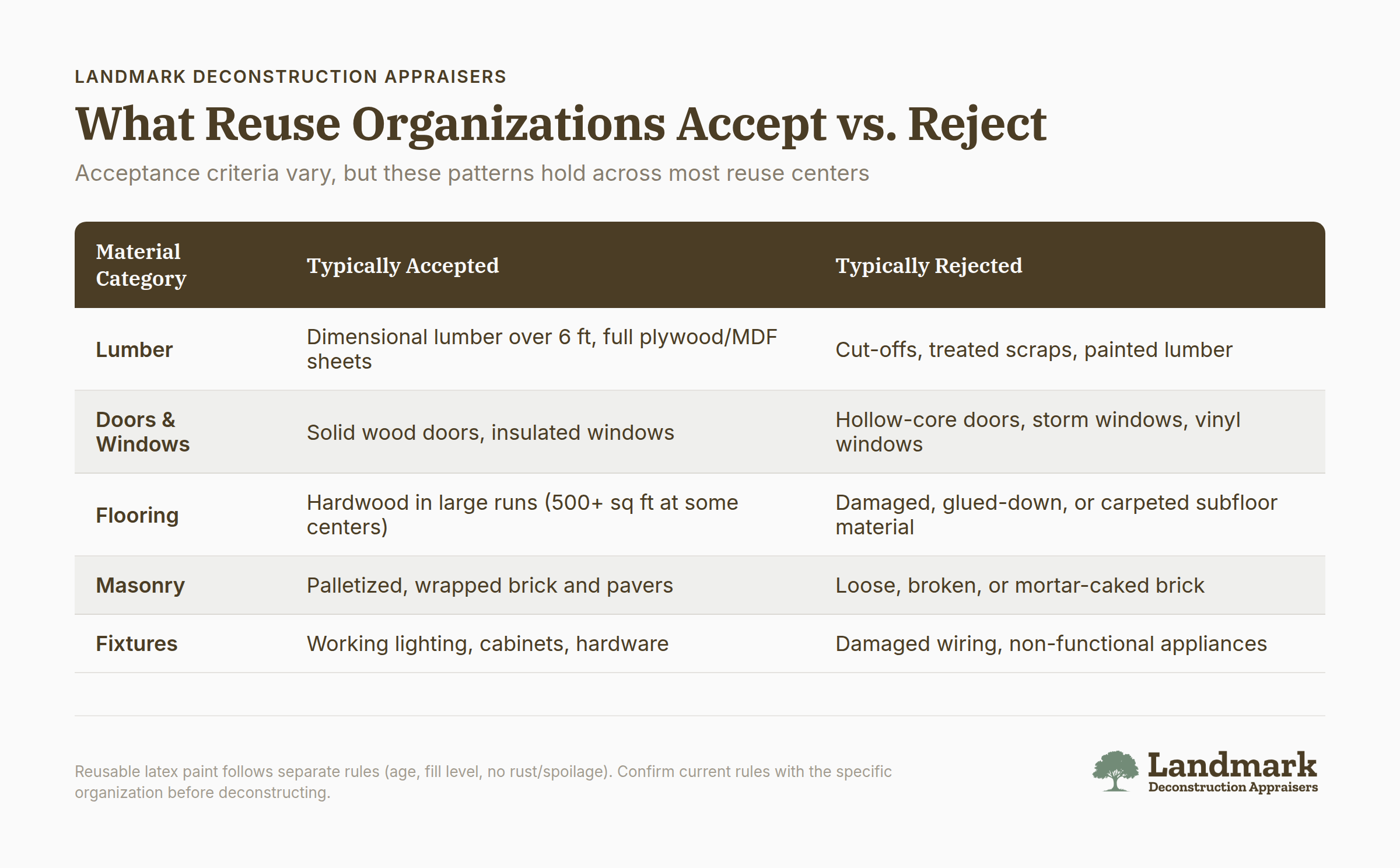
Acceptance criteria vary by organization, but a few patterns hold across most reuse centers.
| Material category | Typically accepted | Typically rejected |
|---|---|---|
| Lumber | Dimensional lumber over 6 feet, full plywood/MDF sheets | Cut-offs, treated scraps, painted lumber |
| Doors and windows | Solid wood doors, insulated windows | Hollow-core doors, storm windows, vinyl windows |
| Flooring | Hardwood in large runs (500+ sq ft at some centers) | Damaged, glued-down, or carpeted subfloor material |
| Masonry | Palletized, wrapped brick and pavers | Loose, broken, or mortar-caked brick |
| Fixtures | Working lighting, cabinets, hardware | Damaged wiring, non-functional appliances |
Some material categories, like reusable latex paint, have their own narrow rules; several reuse centers only accept paint under a certain age, mostly full, and free of rust or spoilage. Always confirm current acceptance rules with the specific organization before you deconstruct around a donation plan.
Put the Paperwork in the Right Order
A building materials donation can be a genuine win: less landfill waste, a working set of cabinets or windows for someone else's project, and a deduction that reflects real value. The part that trips people up is never the deconstruction itself. It's getting the sequence right: deconstruct, document, donate, get the receipt, then commission the appraisal if the value clears $5,000.
If you're planning a gut remodel or teardown and want the appraisal side handled correctly from the start, our team can scope a fixed-fee, IRS-qualified appraisal once your donation and donee receipt are in hand. You can request an appraisal to get that process started.
This article is provided for general informational purposes only and does not constitute legal, tax, or financial advice. Readers should consult a qualified attorney or CPA regarding their specific circumstances.