
Blog
Historic Building Deconstruction and Donation Tax Deductions: What Owners Should Know
Donating materials salvaged during a historic building deconstruction follows the same IRC Section 170 noncash contribution rules as any other personal property gift, not a special preservation deduction. This guide explains the substantiation ladder, the appraisal standards that apply, and why a materials donation is a different strategy than a facade easement.
The Short Answer: Materials Follow Ordinary Noncash Contribution Rules
Developers and owners planning to deconstruct a landmark or historic-designated building often assume that because the structure carries historic status, donating its salvaged materials unlocks a special preservation tax benefit. It does not work that way. Donating materials recovered from a historic building deconstruction is governed by the same ordinary noncash charitable contribution rules under IRC Section 170 that apply to any donated tangible personal property, whether the building has local landmark designation or not.
Our deconstruction donation appraisal services exist because this distinction trips up owners who conflate a building's historic pedigree with the tax treatment of the materials pulled out of it. Historic designation does not increase the deductibility of a doorframe, a run of heart pine flooring, or a cast-iron radiator. What matters is ownership of the materials, their fair market value at the time of the gift, and whether the substantiation rules were followed. This guide walks through that substantiation ladder, the appraisal standards that apply, and why a materials donation and a facade preservation easement are two entirely separate strategies that rarely coexist.
How the IRS Substantiation Ladder Works for Donated Materials
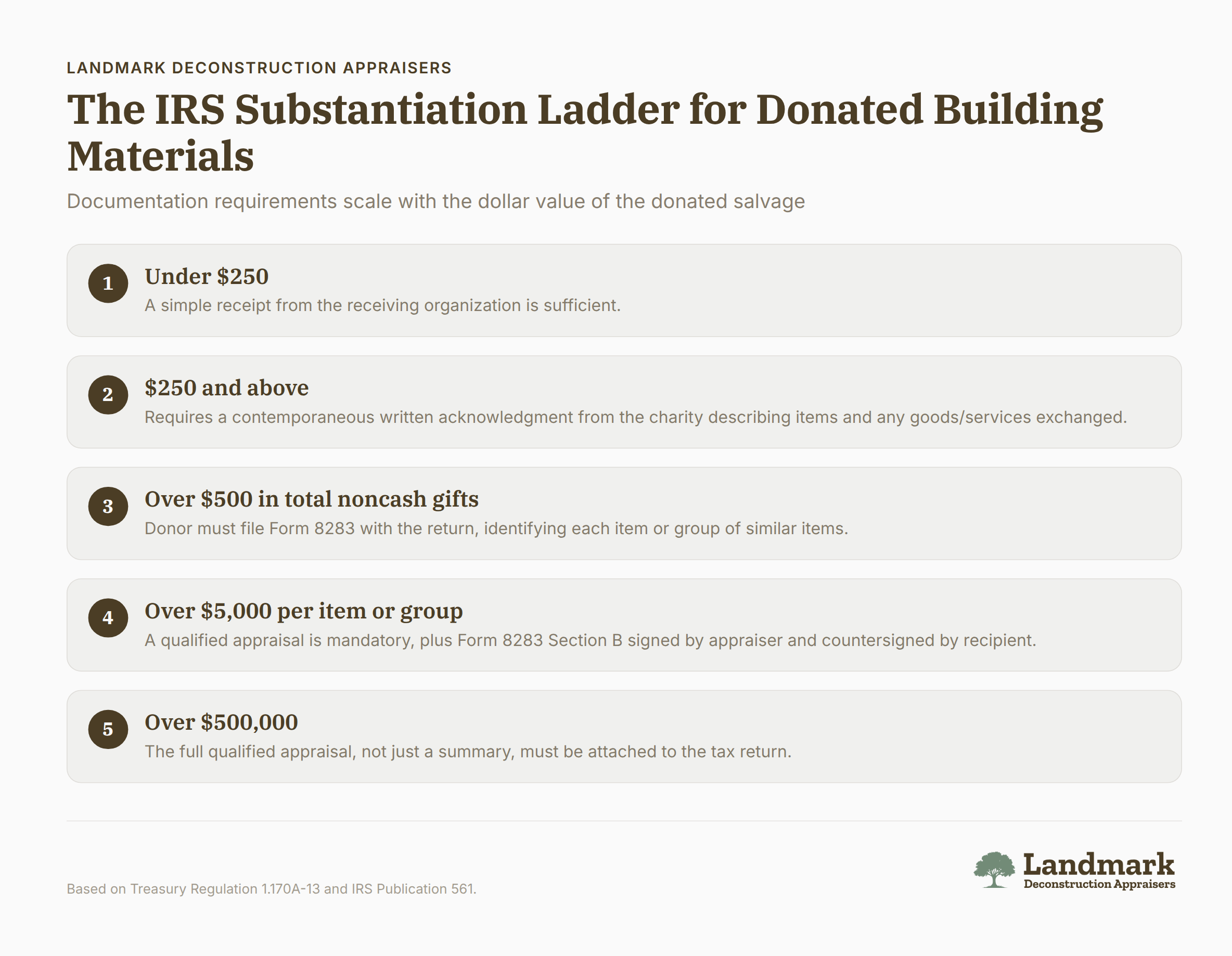
The IRS scales documentation requirements to the dollar value of the gift, and the ladder applies the same way to salvaged doors and millwork as it does to a used sofa. The recordkeeping and return requirements described in Treasury Regulation 1.170A-13 set out the framework donors must follow for noncash charitable contributions.
- Under $250: A simple receipt from the receiving organization is enough.
- $250 and above: The donor needs a contemporaneous written acknowledgment from the charity describing the materials received and confirming whether any goods or services were exchanged.
- More than $500 in total noncash contributions for the year: The donor must file Form 8283 with the tax return, identifying each donated item or group of similar items.
- More than $5,000 for an item or group of similar items: A qualified appraisal becomes mandatory, along with Section B of Form 8283, signed by the appraiser and generally countersigned by the recipient organization. Our guide to completing Form 8283 for building materials donations walks through that section line by line.
- More than $500,000: The qualified appraisal itself, not just a summary, must be attached to the return. IRS Publication 561 confirms this filing requirement for high-value noncash property.
A developer deconstructing a full historic commercial building and donating window units, trim, plumbing fixtures, and structural timber will almost always clear the $5,000 threshold once those items are aggregated as similar property, so the appraisal requirement is the rule rather than the exception on a project of any real size.
Qualified Appraisal Standards for Donated Materials
An appraisal has to satisfy specific requirements to count as a "qualified appraisal" under the tax code, and those requirements trace back to IRC 170(f)(11)(E) and to Treasury Regulation 1.170A-17. Three elements matter most for a deconstruction project.
First, the appraisal has to be prepared by a qualified appraiser, meaning someone with verifiable credentials and demonstrated experience valuing the type of property at issue. Our appraisers hold credentials with organizations such as the ISA, the ASA, and the AAA, and every report is prepared in accordance with the Uniform Standards of Professional Appraisal Practice published by The Appraisal Foundation. Second, timing matters: the appraisal cannot be dated earlier than 60 days before the contribution date, and it cannot be prepared after the due date of the return claiming the deduction. Third, the report has to identify and value each item or group of similar items individually, with the valuation method disclosed, rather than offering one lump figure for a truckload of salvage.
For most building materials donations, we quote the appraisal as a fixed fee after scoping the assignment, driven by the number of material categories, the condition and completeness of the records, and whether the engagement needs to meet IRS-qualified standards. Personal property appraisals of this kind typically start from $295 for IRS-qualified reporting, with multi-category salvage projects running $395 to $2,200 depending on item count and documentation depth. The fee reflects the scope of the work, never the dollar value of the materials themselves.
Materials Donation vs. Facade Preservation Easement: Two Separate Strategies
A materials donation and a historic preservation easement are sometimes discussed as if they are interchangeable tools for the same building. They are not, and confusing the two has derailed real deductions.
A facade or conservation easement under IRC 170(h) requires the donor to grant a qualified organization a perpetual restriction preserving the entire exterior of the building, prohibiting any change inconsistent with its historical character. That requirement only works for a building that stays standing. Deconstructing the structure defeats the conservation purpose the easement was designed to protect, which is why a facade easement and a deconstruction plan are not compatible on the same building at the same time.
The easement path also carries its own strict qualification hurdle. To support this type of contribution, the building generally needs to be a certified historic structure, meaning it is individually listed on the National Register of Historic Places, or located within a registered historic district and certified by the Secretary of the Interior. A local landmark designation alone is usually not enough, a distinction that has surfaced in Tax Court disputes over buildings that carried city or county landmark status without the federal certification the easement rules require. The Sixth Circuit's disallowance of a facade easement deduction in a case involving a defective donation agreement is a reminder that the paperwork for this strategy has to be airtight, well beyond the building's designation status.
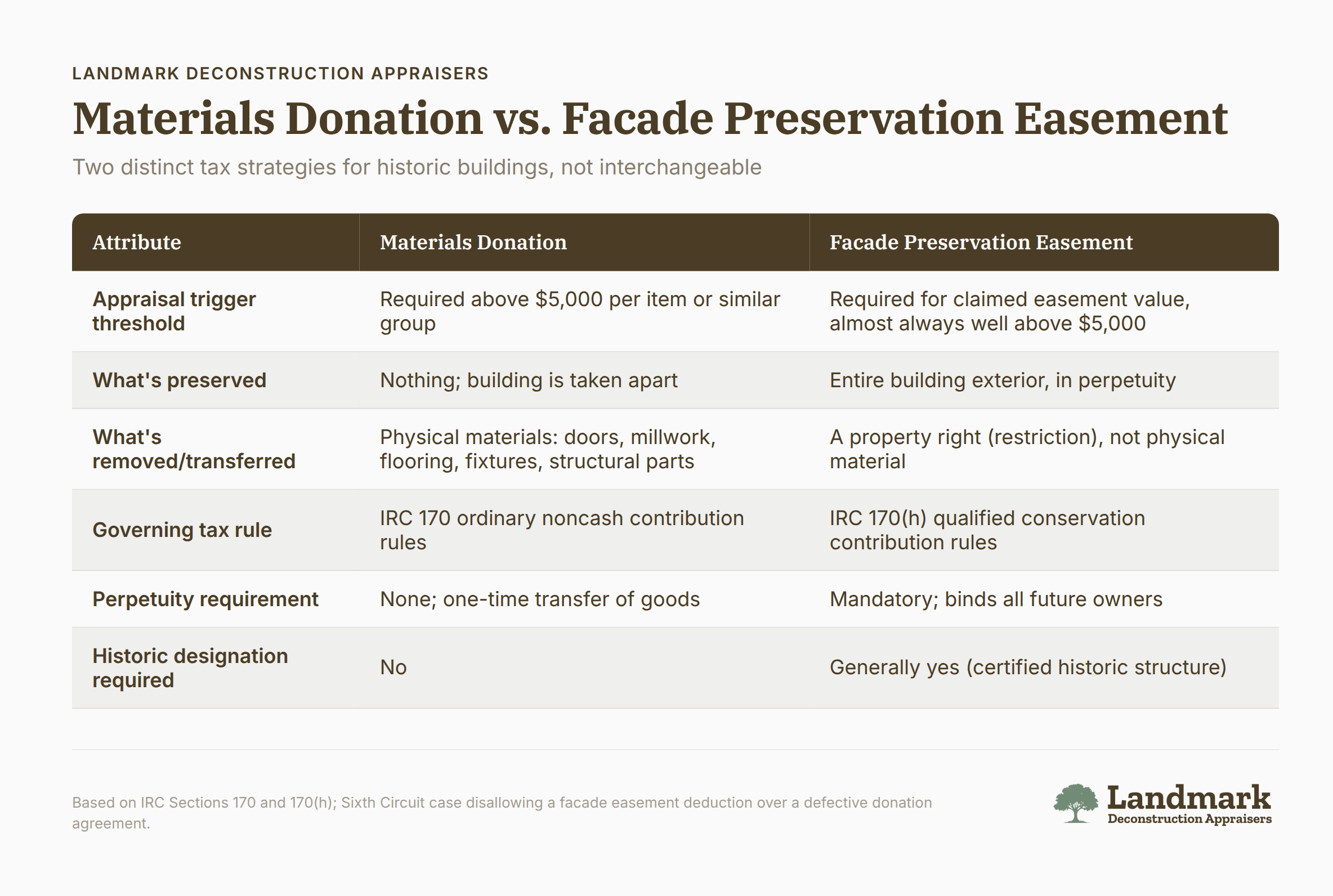
| Materials Donation | Facade Preservation Easement | |
|---|---|---|
| Trigger threshold for appraisal | Qualified appraisal required above $5,000 per item or similar group | Qualified appraisal required for the easement's claimed value, almost always well above $5,000 |
| What's preserved | Nothing; the building is being taken apart | The entire building exterior, in perpetuity |
| What's removed or transferred | Physical materials: doors, millwork, flooring, fixtures, structural components | A property right (the restriction), not physical material |
| Governing rule | IRC Section 170 ordinary noncash contribution rules | IRC Section 170(h) qualified conservation contribution rules |
| Perpetuity requirement | None; a one-time transfer of goods | Mandatory; the restriction must bind all future owners |
| Historic designation required | No | Generally yes (certified historic structure) |
Why a 2019 Federal Case Still Matters for Material Donors
A federal district court in Maryland denied a deduction for materials salvaged from a deconstructed house, and the ruling is a useful warning for any owner planning a similar donation. The court's reasoning did not turn on the building's age or historic character. It turned on the ordinary mechanics of a charitable contribution: establishing that the donor actually owned and transferred the property, and that the claimed value reflected fair market value at the time of the gift rather than the home's original construction cost or the cost the owner avoided by not paying for demolition and disposal.
That distinction trips up more donors than any historic-preservation technicality. A claimed value based on what it would cost to buy brand-new replacement materials, or on what a demolition contractor would have charged to haul the same items to a landfill, is not a substitute for fair market value evidence. The deduction stands or falls on documentation of ownership, condition, and an actual market for the specific items donated.
Does Historic Provenance Affect Fair Market Value?
Yes, but only as one input into a proper valuation, not as a stand-in for one. Reclaimed heart pine flooring, antique hardware, and historic millwork can carry a premium in the reclaimed materials market precisely because of their age and origin, and a qualified appraiser documents that premium through comparable sales data from dealers and salvage markets that trade in similar architectural salvage. Our guide to fair market value for salvaged building materials covers how that comparable-sales analysis is built out item by item.
What provenance cannot do is replace the analysis entirely. A report that states "this trim is historic, therefore it is worth $40,000" without comparable sales, condition notes, and quantity detail will not meet the qualified appraisal standard, regardless of how compelling the building's history is.
Coordinating Deconstruction, Donation, and a Preservation Easement
For a developer or owner sitting on a landmark-designated building, the practical path forward usually involves treating any materials donation and any preservation easement as two completely separate transactions, each documented on its own terms.
- Decide early whether an easement is part of the plan. If a facade or conservation easement is on the table, it has to be recorded before deconstruction begins, and the deconstruction scope has to be checked against the easement's terms so the restriction is not violated.
- Scope the materials donation independently. Once the building's exterior fate is settled, the materials donation gets its own qualified appraisal if the $5,000 threshold is crossed, valued on its own fair market value evidence.
- Bring in preservation counsel and a CPA before the first wall comes down. Coordinating the easement's legal terms, the project's tax accounting treatment, and the materials appraisal before work starts avoids the kind of defective agreements and mismatched documentation that have sunk deductions in court.
- Keep the two appraisals and the two sets of records entirely separate. An easement appraisal values a real property interest; a materials appraisal values personal property. Mixing the two, or trying to use one valuation to support both claims, invites exactly the scrutiny these rules are designed to withstand.
Handled this way, a landmark building's deconstruction can still generate a legitimate, well-documented materials deduction even when a preservation easement is not part of the plan, and an easement strategy on a different building can proceed without being compromised by a deconstruction project elsewhere on the site.
This article is provided for general informational purposes only and does not constitute legal, tax, or financial advice. Readers should consult a qualified attorney or CPA regarding their specific circumstances.