
Blog
How Fair Market Value Is Determined for Salvaged Building Materials Donations
Fair market value for donated salvaged building materials comes from actual resale prices in the architectural salvage and reuse market, adjusted for condition, not from replacement cost or a contractor's retail markup. Here is how the Mann case and IRS Publication 561 define the correct method, and what it means for your deduction.
When you donate salvaged building materials from a deconstruction project, the IRS does not let you deduct what new materials would cost to replace them. It wants the price those doors, beams, and fixtures would actually bring if sold, used, in the reclaimed materials market. Our deconstruction donation appraisal service exists largely because donors get this backwards, and the mistake can cost them the entire deduction.
What Fair Market Value Means for Donated Building Materials
Fair market value is the price a salvaged item would bring between a willing buyer and a willing seller, neither one under pressure to act, both reasonably informed about the item's condition and the market for it. That is the standard IRS Publication 561 sets for every kind of non-cash donation, salvaged lumber and fixtures included. Publication 561 goes further and flags replacement cost, what it would cost to buy the item new, as an unreliable stand-in for fair market value whenever it has no reasonable relationship to what the item would actually sell for used.
That single distinction is the crux of nearly every disallowed deconstruction deduction our appraisers have reviewed. It applies whether your deduction is for $600 or $60,000, though the paperwork changes once you cross the $5,000 mark that triggers a qualified appraisal requirement, which we cover in more detail in our guide on when a qualified appraisal is required for building material donations over $5,000.
Why the Mann Case Rejected a Replacement-Cost Appraisal
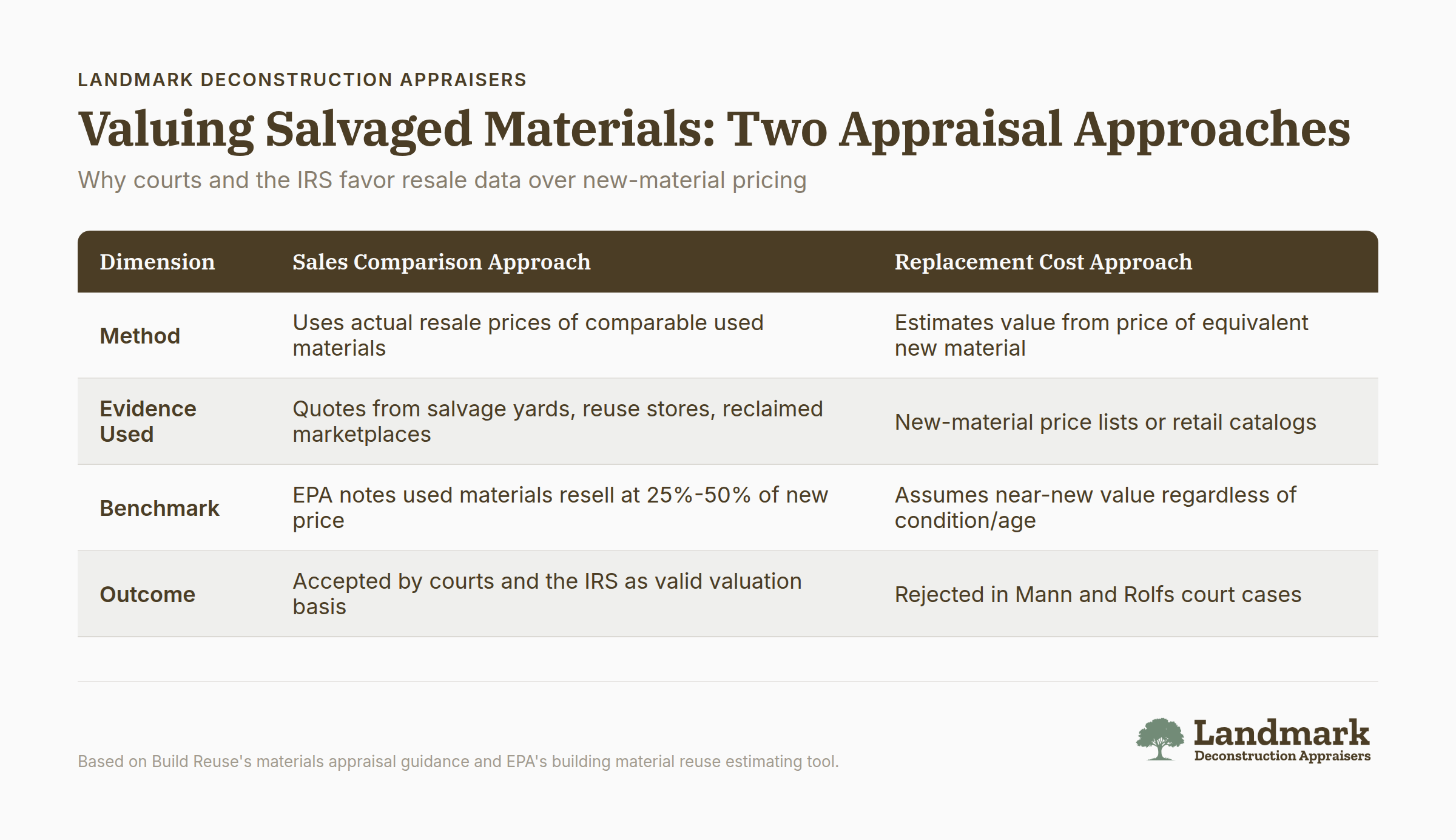
Donors who deduct salvaged materials at replacement cost run into the same wall the taxpayers hit in Mann v. United States. The Fourth Circuit, in a decision reviewed by The Tax Adviser, upheld the IRS's rejection of an appraisal that valued a donated house's components using a cost-based methodology instead of actual resale evidence.
The court's reasoning traced back to Rolfs v. Commissioner, a Seventh Circuit decision holding that the correct way to value a deconstruction donation is the resale value of the specific materials removed, item by item, not a cost-new-minus-depreciation calculation applied to the structure as a whole. Courts have consistently favored actual market evidence over theoretical cost math for this asset type, and that preference now shapes how any credible appraiser approaches the assignment.
Watch out: An appraisal that starts from a construction estimate or an insurance replacement schedule, then applies a flat depreciation percentage, is built on the exact methodology courts have already rejected. If your appraiser's worksheet looks like a repair estimate, ask questions before you file.
The Sales Comparison Approach Is the Standard for Salvaged Materials
Qualified appraisers value salvaged building materials using the sales comparison approach: they locate actual sale prices for comparable used materials and adjust for differences in condition, age, and completeness. Build Reuse's guidance on materials appraisals confirms this directly, noting that appraisers should compare donated items with sale prices from used building material dealers and reuse retailers, not extrapolate from new-material pricing.
Where direct comparables are thin, appraisers start with broader industry benchmarks and refine from there. The EPA's building material reuse estimating tool notes that used materials typically resell for 25% to 50% of the price of equivalent new material, a rough starting point that gets narrowed once the appraiser pulls quotes from specific salvage yards, reuse stores, or reclaimed materials marketplaces serving the donor's region.
How Condition Grading Changes What a Salvaged Item Is Worth
Two doors salvaged from the same 1920s house can carry very different fair market values once an appraiser grades their condition. Appraisers assess several factors before assigning a value to each category of salvaged material:
- Structural integrity: whether the item is sound enough for its original function or needs significant repair before reuse.
- Finish quality: the state of paint, stain, hardware, and surface wear that a buyer in the reuse market would notice immediately.
- Completeness: whether all original parts, hardware, and matching pieces are present, since incomplete sets sell for less than full sets.
- Removal and installation damage: cracks, splits, or fastener holes left from how the item was taken out of the structure, which reduce resale value even when the underlying material is otherwise sound.
Example: Two matching six-panel doors salvaged from the same demolition might carry a combined new-replacement cost of $600, yet one with intact hardware and no cracking could sell in the reclaimed market for $150, while its water-damaged twin, missing a hinge, might bring only $40. The appraiser values each door on its own condition grade, not as a matched pair priced off a catalog.
Why a Contractor's Retail Price Isn't Evidence of Fair Market Value
A contractor's resale price list or a big-box store's price for equivalent new material is not evidence of fair market value, and an appraisal that leans on either one is unlikely to hold up if the IRS asks questions. Retail resale pricing bakes in a contractor's profit margin and overhead; new-material pricing describes a different product entirely, since new and used items do not compete for the same buyer.
Guidance from deconstruction appraisal specialists makes the same point: the deduction traces back to what the specific materials would sell for in the reuse market, not what a contractor charges a homeowner to install comparable new materials, and not a donor's own retail price sheet even if they happen to run a salvage business.
Pro tip: Ask your appraiser for the actual comparable sales used, not just a percentage discount off retail. A defensible report names the venue (a specific salvage yard, reuse store, or online marketplace) and the sale price for each comparable item.
Dollar Thresholds That Trigger a Qualified Appraisal
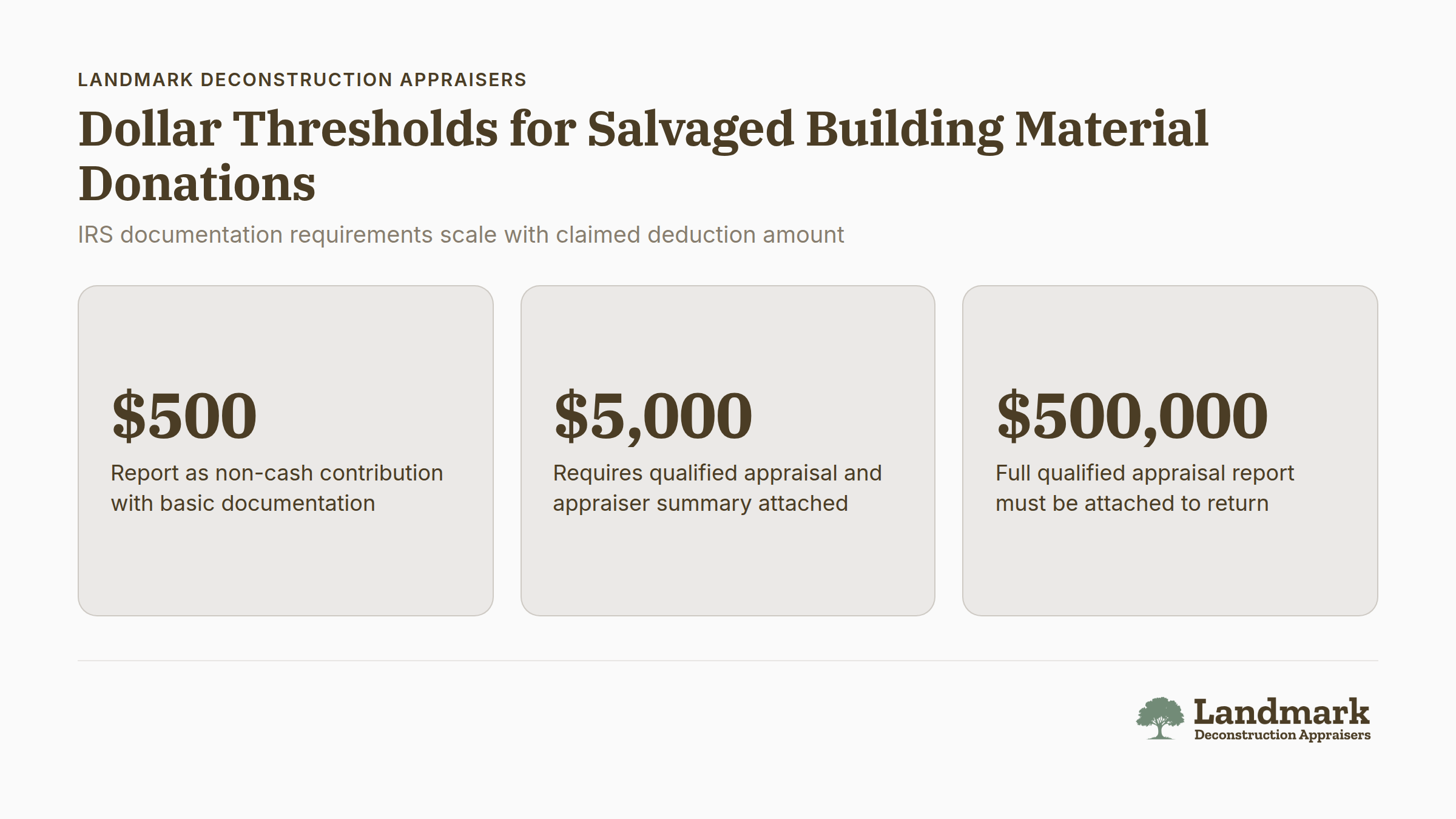
Once your claimed deduction for an item or group of similar salvaged materials passes $5,000, the IRS requires a qualified appraisal prepared by a qualified appraiser and a completed summary attached to your return. Two other thresholds matter for building material donors:
- $500 and above: the donation generally must be reported as a non-cash contribution on your return, with basic documentation of what was donated and to whom.
- $5,000 and above for an item or group of similar items: triggers the qualified appraisal requirement described above.
- $500,000 and above: the qualified appraisal report itself, not just a summary, must be attached to your return.
Getting the Valuation Right Before You File
The fastest way to lose a deduction on donated building materials is to hand your accountant a number based on new-material pricing or a contractor's retail sheet. Fair market value for salvaged doors, flooring, fixtures, and lumber comes from one place: what those specific, condition-graded items would actually sell for in the secondary market on the date you donated them. Our appraisers are experienced with the reclaimed materials market and prepare reports in accordance with USPAP, built around real comparable sales rather than cost math the IRS and the courts have already rejected.
If you are planning a deconstruction donation and want a valuation that will stand up to review, request an appraisal before you file.
This article is provided for general informational purposes only and does not constitute legal, tax, or financial advice. Readers should consult a qualified attorney or CPA regarding their specific circumstances.